The Quiz Question
Lindisfarne raid of AD 793 is remembered as the start of the Viking Age mainly because of what?
- A. It was the first time longships were used
- B. It struck one of Christendom's holiest monasteries, shocking all of Europe
- C. It introduced runic writing to Britain
- D. It ended in a formal peace treaty
The answer is B. It struck one of Christendom's holiest monasteries, shocking all of Europe. Here is the full story.
Why the Lindisfarne Raid Changed the World
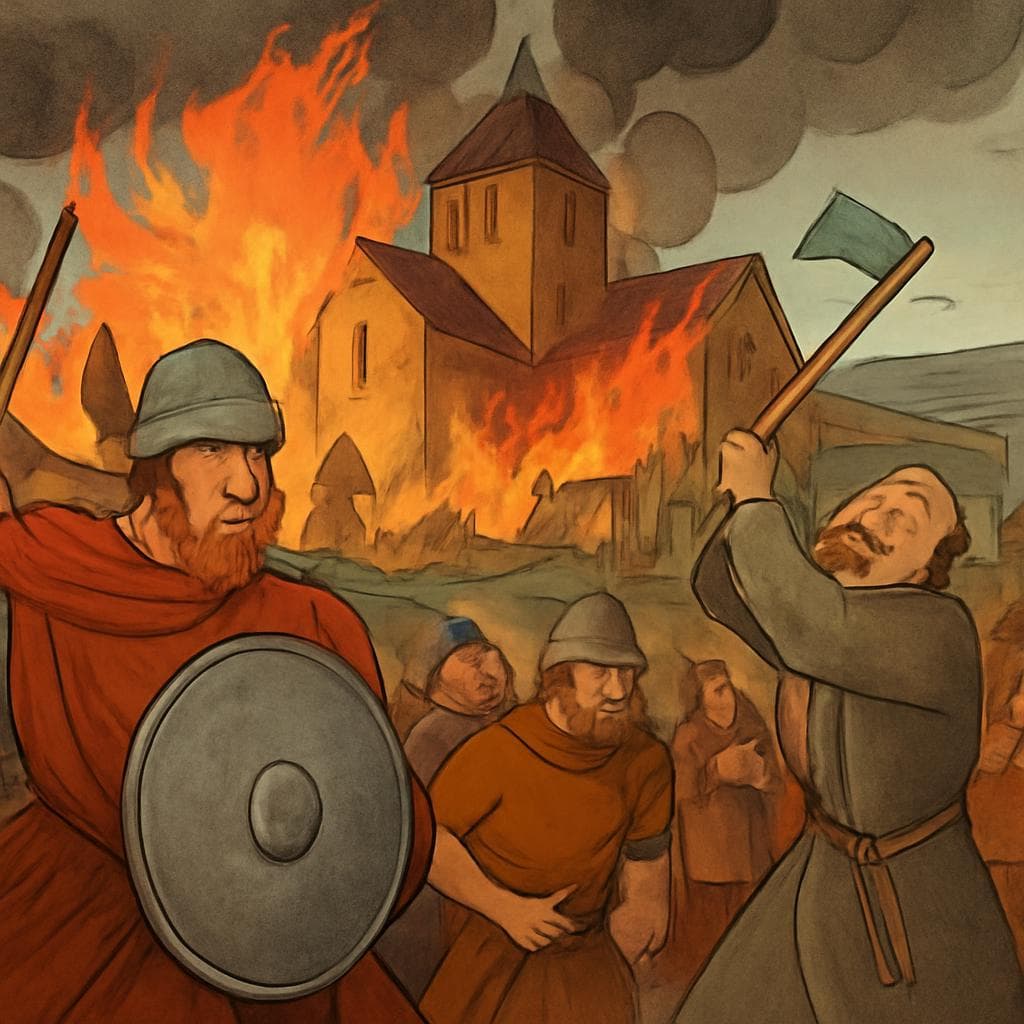
On 8 June 793, longships appeared out of the North Sea mist and struck the monastery of Lindisfarne, a tiny tidal island off the northeast coast of England. The raiders killed monks, threw others into the sea, looted the treasury, and vanished as quickly as they had come. It wasn't the first Norse raid on British shores, but it became the moment that burned itself into the memory of an entire civilization.
A Target That Hit at the Heart of Christian Europe
Lindisfarne wasn't just any monastery. Founded in 635 by the Irish monk St Aidan, it was one of the most revered spiritual sites in the whole of Christendom. It was the home of the Lindisfarne Gospels, one of the most spectacular illuminated manuscripts ever produced, and the resting place of St Cuthbert, the most celebrated saint of northern England. Attacking Lindisfarne was, to the Christian world, roughly equivalent to bombing a cathedral and a national museum simultaneously.
The scholar Alcuin of York — then working at the court of Charlemagne — wrote letters almost immediately expressing horror. "Never before has such terror appeared in Britain," he wrote. His words echo the shockwave that rolled across literate Europe. When Charlemagne's most prominent intellectual reacts in genuine disbelief, you know the raid had cut deep into the collective psyche.
Why This Raid, and Not an Earlier One?
Here's the nuance historians love to point out: the Vikings had already attacked the monastery at Portland on the Dorset coast a few years earlier, around 789. So technically, Lindisfarne wasn't the absolute first Norse raid. But Portland barely registered. Lindisfarne, because of its sacred status, produced written records, anguished correspondence, and entries in the Anglo-Saxon Chronicle that preserved the event for posterity. History is often less about what happened and more about what got written down and remembered.
The Ripple Effect Across Centuries
The 793 raid set off a psychological alarm bell that never really stopped ringing for the next 250 years. Monasteries across Britain and Ireland scrambled to protect their treasures. Coastal communities began living in a state of watchful dread. The phrase furore Normannorum libera nos, Domine — "From the fury of the Northmen, deliver us, O Lord" — entered liturgical tradition as a genuine prayer of terror, not a rhetorical flourish.
Beyond fear, the raid also signalled something larger: Scandinavia was entering a period of outward expansion driven by population pressure, limited farmland, and advances in shipbuilding. The Vikings would go on to settle Iceland, reach North America, trade with Baghdad, and reshape the political map of Europe.
Lindisfarne was the opening act of all of that — not because it was the very first raid, but because it was the one that made the whole of Europe sit up and realise something fundamental had changed.