The Quiz Question
Battle of Crecy in 1346 became a turning point in warfare largely because of what?
- A. The first recorded use of gunpowder cannon
- B. English longbowmen decimating French knights and crossbowmen
- C. A surprise naval ambush
- D. The introduction of plate armour
The answer is B. English longbowmen decimating French knights and crossbowmen. Here is the full story.
The Battle That Changed Medieval Warfare Forever
On the evening of 26 August 1346, a French army that vastly outnumbered its English opponents charged across a hillside in northern France — and walked straight into one of the most devastating killing grounds in medieval history. What happened at Crécy didn't just decide a battle; it announced that the age of armoured cavalry supremacy was drawing to a close.
The English Position
King Edward III had chosen his ground carefully. His army of roughly 12,000 men was positioned on a ridge near the village of Crécy-en-Ponthieu, with the setting sun at their backs and a gentle slope in front. He divided his forces into three divisions and placed his longbowmen on the flanks in a distinctive "harrow" formation — angled outward so that arrows could converge on any attacking force like a closing vice.
The English longbow itself was a fearsome weapon. Crafted from yew, standing around six feet tall, it could drive a yard-long arrow through chain mail at 200 yards. A trained English or Welsh archer could loose between ten and twelve arrows per minute — a rate of fire that crossbows simply could not match.
The Genoese Crossbowmen Get Shredded
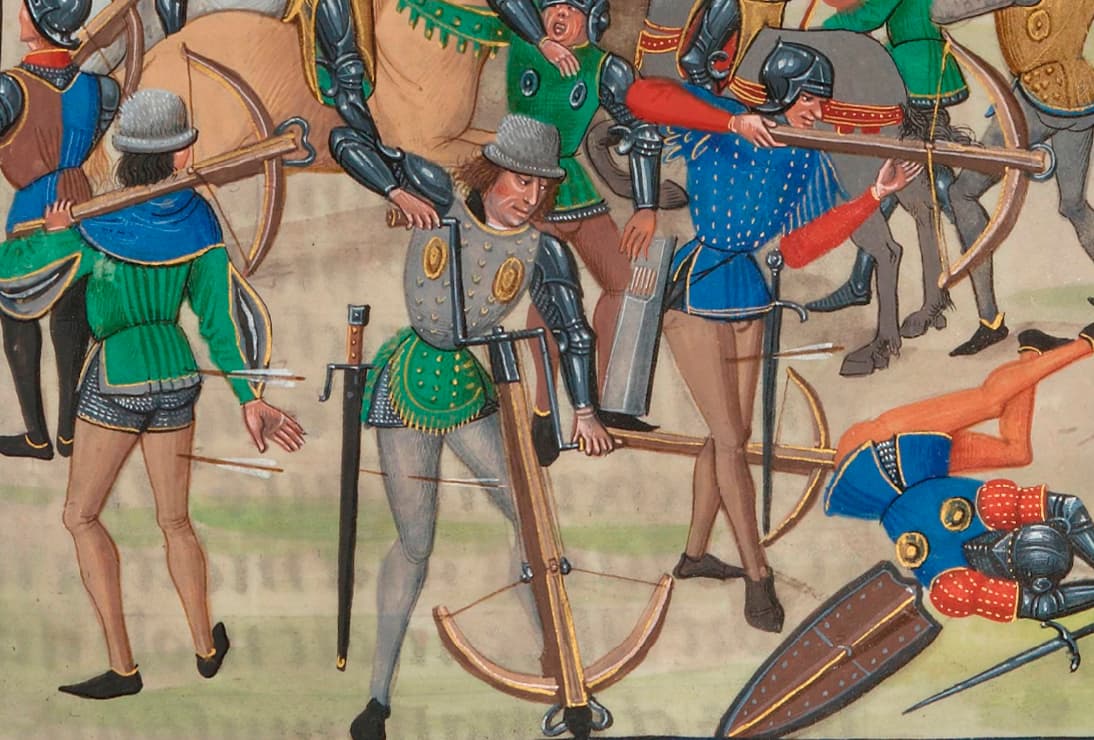
Philip VI of France opened the battle by sending forward around 6,000 Genoese mercenary crossbowmen to soften up the English line. It didn't go well. Their bowstrings had been dampened by an earlier rainstorm, reducing their range and power. The English longbowmen, whose strings were kept dry, opened fire first and unleashed a storm of arrows that tore through the Genoese ranks before they could even get within effective range.
Making matters catastrophically worse, the impatient French knights behind the Genoese — frustrated by the retreat of the mercenaries — rode forward and trampled their own allies underfoot before charging the English line themselves.
Knights Cut Down Like Wheat
What followed was a slaughter. The French cavalry charged uphill, repeatedly, into a relentless wall of arrows. Historians estimate the French launched fifteen or sixteen separate charges that evening. Each time, the longbowmen loosed thousands of shafts into horses and riders. Horses screamed and fell; knights piled on top of each other in the chaos. Even when some knights reached the English lines, they were exhausted and disordered — easy prey for the English men-at-arms waiting for them.
When the carnage was over, around 1,500 French knights and nobles lay dead, along with thousands of foot soldiers. English losses were minimal.
Why It Mattered
Crécy shattered a central assumption of medieval warfare — that heavily armoured knights on horseback were the decisive force on any battlefield. It demonstrated that disciplined infantry, armed with the right ranged weapon and fighting from a strong position, could stop cavalry cold. The lesson would be reinforced at Poitiers in 1356 and Agincourt in 1415, cementing the longbow's legacy as a true game-changer in the history of warfare.