The Quiz Question
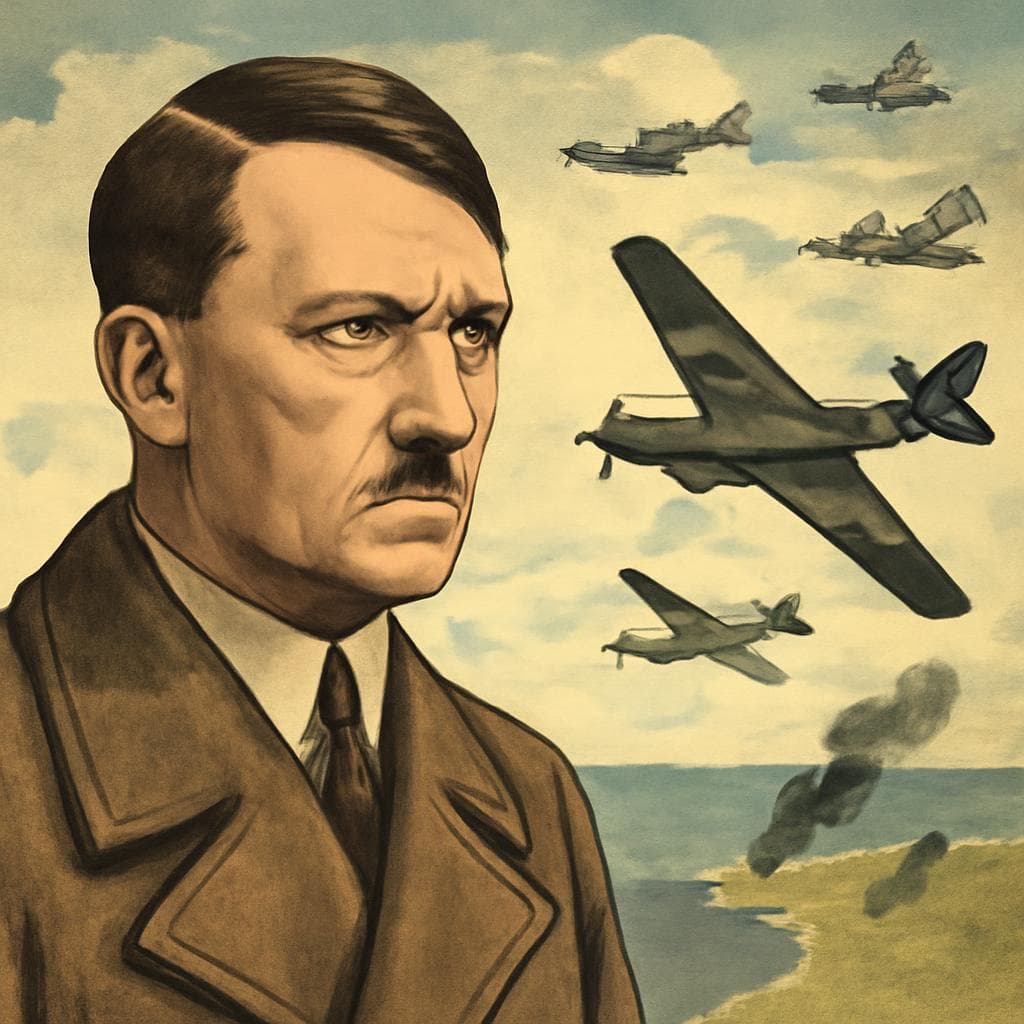
Hitler ordered the Luftwaffe into the Battle of Britain in 1940 mainly to achieve what?
- A. Air superiority to clear the way for a Channel invasion
- B. The capture of the Royal Family
- C. Destruction of Britain's entire navy
- D. Control of British oil refineries
The answer is A. Air superiority to clear the way for a Channel invasion. Here is the full story.
Operation Sea Lion: Hitler's Dream of Invading Britain
By the summer of 1940, Hitler had swept through Western Europe at breathtaking speed. France had fallen, the Low Countries were occupied, and Nazi Germany controlled most of the continent. But one stubborn obstacle remained: Britain, sitting defiantly across the English Channel, refusing to negotiate peace.
Hitler's solution was Operation Sea Lion — a full-scale amphibious invasion of southern England. The plan called for German troops to land along a broad stretch of coastline from Ramsgate to Lyme Bay, pushing inland to encircle London. On paper, it looked bold. In practice, it had a massive problem.
Why the Luftwaffe Had to Go First
The German Navy, the Kriegsmarine, was in no shape to take on the Royal Navy in open water. British warships would have torn the slow, improvised invasion fleet — largely consisting of converted river barges — to pieces. The only way to neutralise that threat was from the air. If the Luftwaffe could destroy RAF Fighter Command and establish air superiority over southern England and the Channel, German aircraft could then keep Royal Navy ships away from the invasion corridor.
Hermann Göring, head of the Luftwaffe, was confident his air force could do it. He promised Hitler that Fighter Command could be broken within weeks. The campaign began in earnest in August 1940, targeting RAF airfields, radar stations, and sector control rooms — the nervous system of British air defence.
How Close It Actually Came
For a few critical weeks in late August and early September 1940, the Luftwaffe's strategy was working. RAF Fighter Command was bleeding badly. Experienced pilots were being killed or wounded faster than they could be replaced, airfields were badly damaged, and the pressure on Air Chief Marshal Hugh Dowding's 11 Group was immense.
Then Göring made a catastrophic decision. After the RAF bombed Berlin in late August — a pinprick raid, but a humiliating one — Hitler ordered the Luftwaffe to shift its attacks to London. The Blitz had begun. It relieved the pressure on Fighter Command at exactly the wrong moment, giving the RAF time to recover, regroup, and keep fighting.
September 1940: The Turning Point
On 15 September 1940 — now celebrated as Battle of Britain Day — the Luftwaffe launched its largest daylight raids on London and was met with fierce, organised resistance. The losses were unsustainable. Two days later, Hitler quietly postponed Operation Sea Lion "indefinitely." It was never seriously revived.
The Battle of Britain was the first major campaign in history fought entirely in the air, and it mattered enormously. Had the Luftwaffe succeeded, an invasion of Britain would have become a genuine possibility. Instead, Britain survived to become the base from which the eventual liberation of Europe was launched four years later.
Winston Churchill's famous tribute still captures it perfectly: "Never in the field of human conflict was so much owed by so many to so few."