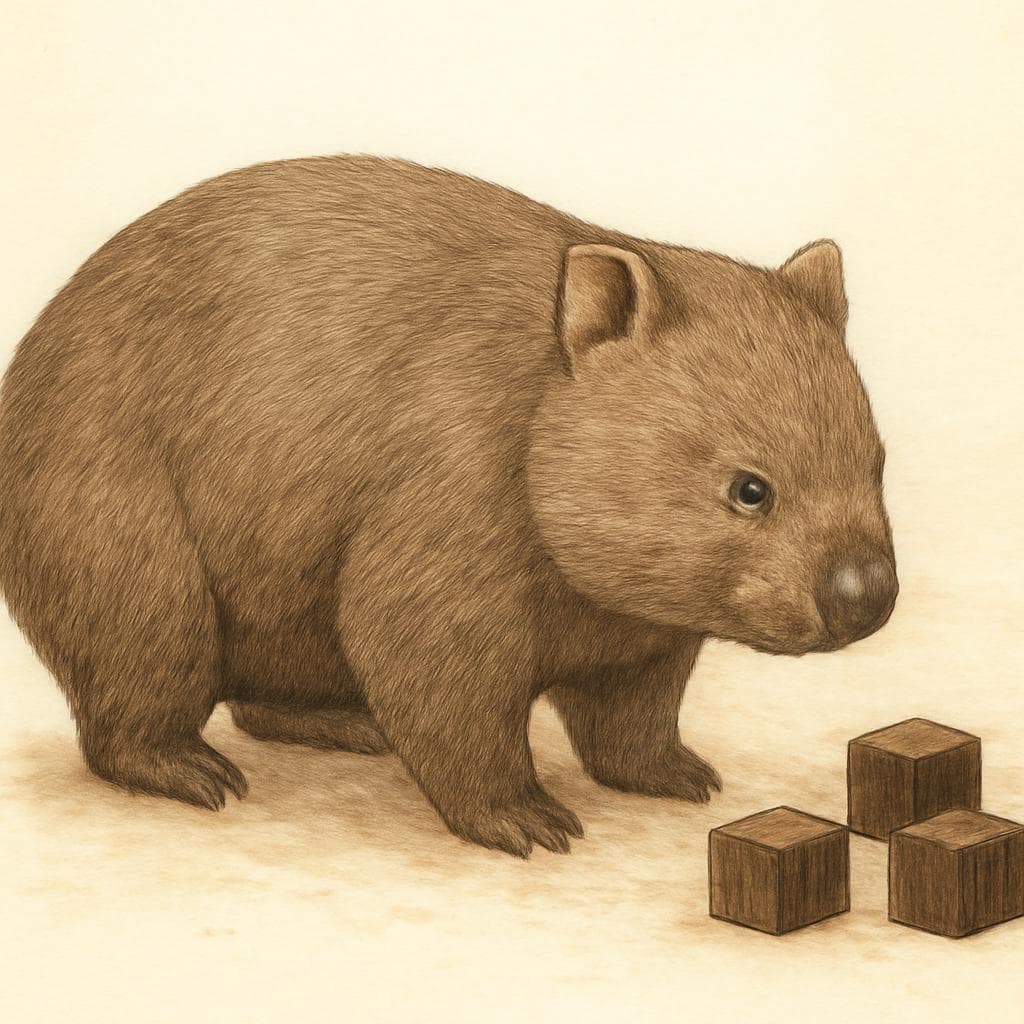
The Quiz Question
Wombat poop is cube-shaped
- A. True
- B. False
- C. Sometimes
- D. Rectangular
The answer is A. True. Here is the full story.
The Animal Kingdom's Only Square Poop
Yes, it's true — and it's one of the strangest, most delightful facts in all of biology. Wombats, the stocky, burrowing marsupials native to Australia, are the only animals on Earth known to produce cube-shaped droppings. Not approximately cube-shaped. Actually cube-shaped, with distinct flat sides and sharp-ish corners. Scientists spent years trying to figure out how on earth that happens.
Why the Cube Shape Matters to a Wombat
Wombats are territorial animals, and they communicate heavily through scent marking. They deposit their droppings in prominent spots — on rocks, logs, and raised ground — to signal their presence to other wombats. A cube has a crucial advantage here: it doesn't roll away. Round droppings on an uneven surface would tumble off a log or rock. A cube stays put, keeping the message exactly where the wombat left it. Nature, as usual, found a very practical solution.
The Science Behind the Shape
For a long time, researchers assumed wombats must have a square-shaped rectum or some kind of rigid mold at the end of their digestive tract. It turns out the reality is far more interesting. A 2021 study published in the journal Soft Matter by researchers including Patricia Yang at Georgia Tech revealed the actual mechanism.
The wombat's intestine has varying elasticity along its length. Two stiff grooves, spaced about 90 degrees apart, run along sections of the intestinal wall. As the fecal matter dries and firms up during its long journey through the digestive system — wombats have an exceptionally slow digestion, taking up to 22 days to process food — these stiffer regions create the corners of the cube. The softer sections in between form the flat faces. It's essentially biological origami, shaped by the uneven properties of the gut wall rather than by any rigid structure.
A Discovery That Won an Ig Nobel Prize
The research into wombat cube poop earned its scientists an Ig Nobel Prize in 2019 — the awards given for research that "first makes people laugh, then makes them think." But the work is genuinely serious. Understanding how soft biological tissues can produce complex shapes has real implications for manufacturing and engineering. Producing cube or other non-round shapes from a soft, flexible tube is a problem engineers actually care about, and wombat intestines already solved it millions of years ago.
A Few Extra Wombat Facts Worth Knowing
Wombats produce around 80 to 100 of these little cubes every single night. They are also built like furry tanks, with cartilaginous plates in their backside that they use to block burrow entrances and crush predators against the tunnel walls. The cube poop is just one chapter in the surprisingly hardcore life of the wombat.
Next time someone calls a fact "too weird to be true," remind them that an animal producing perfectly cube-shaped droppings through the elasticity of its gut is not only true — it's been published in a peer-reviewed journal and inspired engineering research.