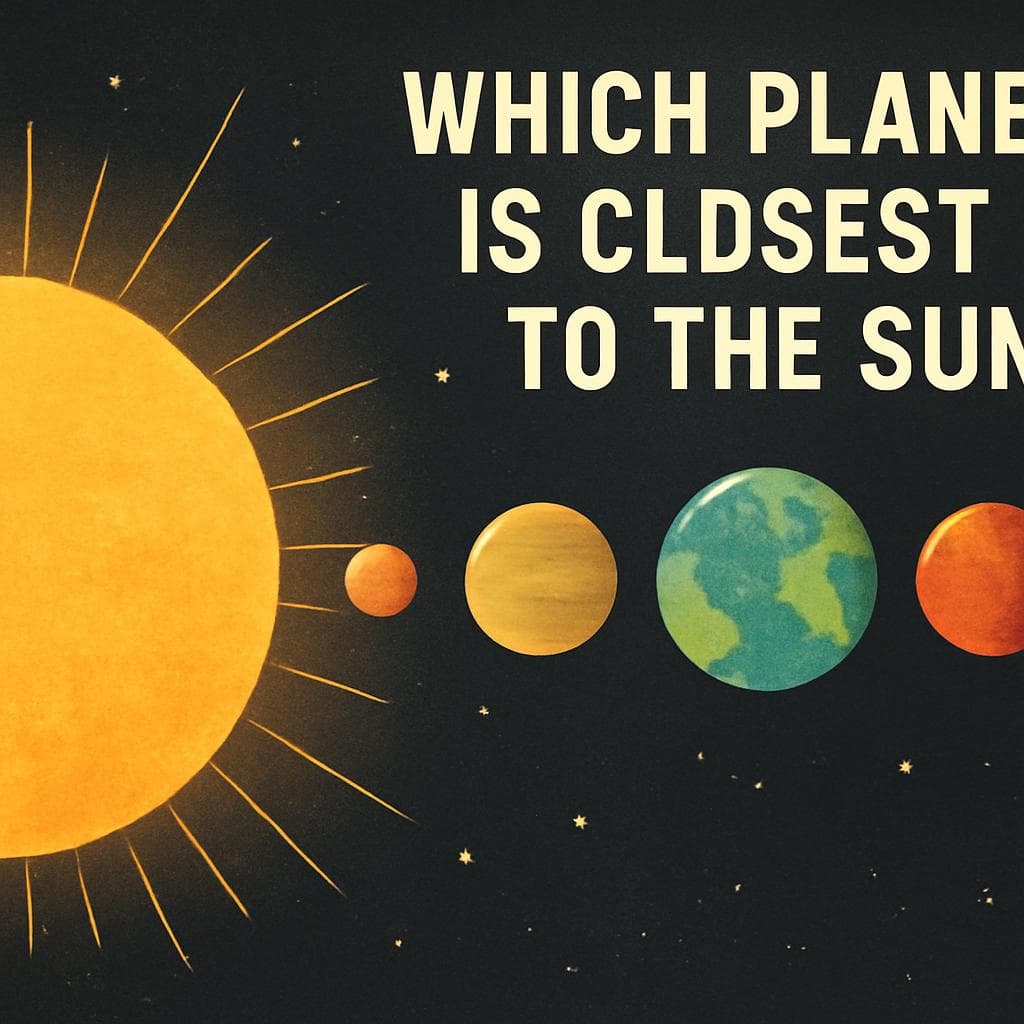
The Quiz Question
Which planet is closest to the sun?
- A. Venus
- B. Earth
- C. Mercury
- D. Mars
The answer is C. Mercury. Here is the full story.
Mercury: The Solar System's Speed Demon
Sitting just 58 million kilometres from the Sun on average, Mercury is our solar system's innermost planet — a small, battered world that races around the Sun faster than any other planet in our cosmic neighbourhood.
A Year That Lasts 88 Days
Because Mercury is so close to the Sun, its orbital path is much shorter than Earth's. It completes a full trip around the Sun in just 88 Earth days. That means while you're still writing the wrong year on documents in January, Mercury has already lapped the Sun once. Its orbital speed is equally impressive — it travels at roughly 47 kilometres per second, compared to Earth's relatively leisurely 30 km/s.
Close to the Sun, But Not the Hottest
Here's the fact that trips people up every time: Mercury is not the hottest planet. That title belongs to Venus. Mercury has virtually no atmosphere to trap heat, so while the Sun-facing side scorches at around 430°C, the night side plunges to a brutal -180°C. Without an atmospheric blanket, the heat simply vanishes into space the moment the Sun goes down.
A Surprisingly Heavy Little World
Mercury is only slightly larger than Earth's Moon, but it's surprisingly dense. Scientists believe it has an enormous iron core that makes up roughly 85% of its radius — a far greater proportion than any other planet. One leading theory suggests a giant impact early in the solar system's history stripped away much of Mercury's outer rocky mantle, leaving that oversized core behind.
A Day Longer Than Its Year
Perhaps Mercury's strangest quirk is its slow rotation. It spins so sluggishly on its axis that a single Mercury day — from one sunrise to the next — lasts about 176 Earth days. That means Mercury's day is actually twice as long as its year. It's one of the most counterintuitive facts in planetary science.
What We Know From Visiting It
Only two spacecraft have ever visited Mercury up close. NASA's Mariner 10 flew by in the 1970s, and the MESSENGER probe orbited the planet from 2011 to 2015, eventually crashing into the surface on purpose. The images revealed a cratered, Moon-like landscape and, surprisingly, confirmed the presence of water ice hiding in permanently shadowed craters near the poles — places the Sun's rays never reach.
The European-Japanese BepiColombo mission, launched in 2018, is currently en route and expected to enter Mercury's orbit in 2026, promising a whole new wave of discoveries about this small but fascinating world right on the Sun's doorstep.