The Quiz Question
Which planet in our solar system has the shortest day?
- A. Mercury
- B. Earth
- C. Jupiter
- D. Mars
The answer is C. Jupiter. Here is the full story.
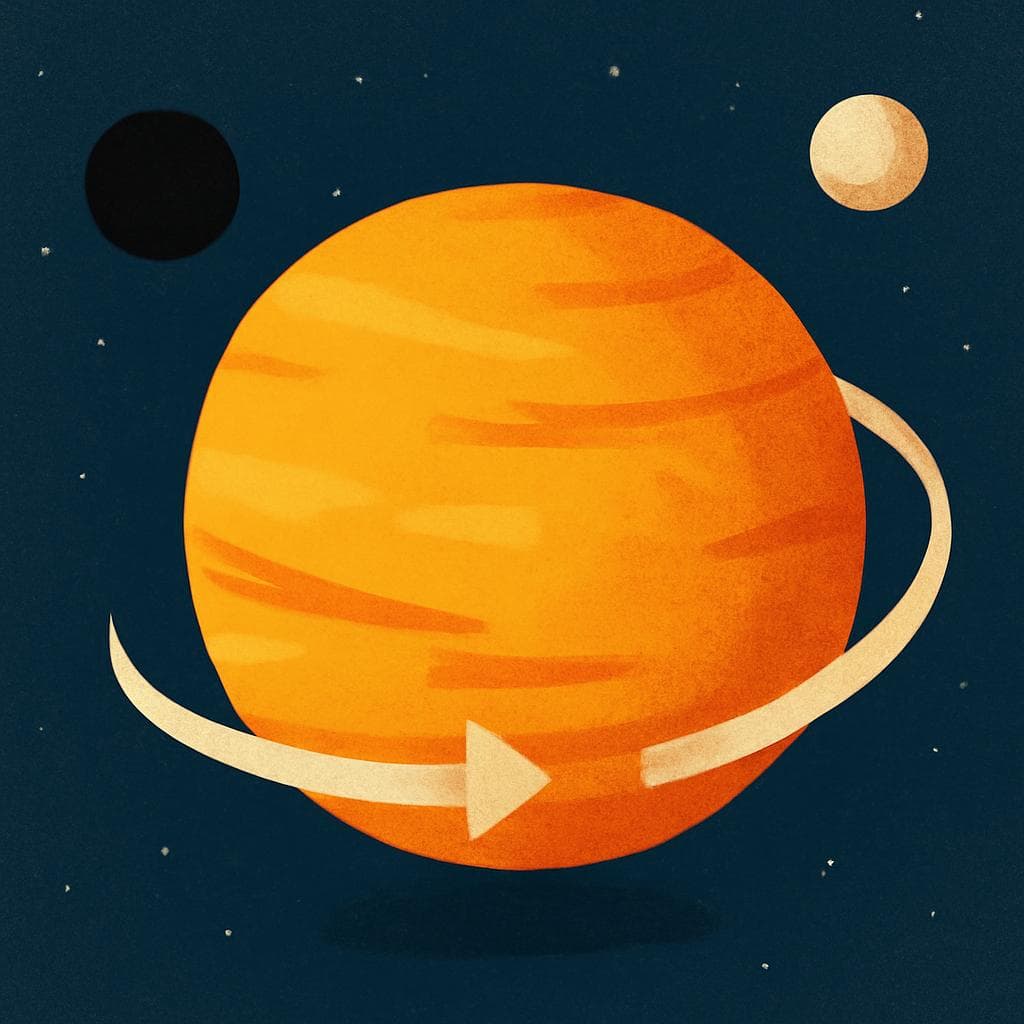
Jupiter Spins Faster Than Any Other Planet
For a planet so enormous it could swallow more than 1,300 Earths, Jupiter moves with remarkable speed. It completes a full rotation in just about 10 hours, giving it the shortest day of any planet in our solar system. To put that in perspective, while you sleep through a single night on Earth, Jupiter has already spun more than halfway through its day.
Why Does Size Matter Here?
You might expect the biggest planet to be the slowest spinner — but physics doesn't work that way. Jupiter formed from an enormous collapsing cloud of gas and dust, and as that material pulled inward under gravity, it spun faster and faster. Think of a figure skater pulling their arms in mid-spin. That same principle — conservation of angular momentum — is why Jupiter ended up rotating so rapidly despite its massive size.
Since Jupiter formed with so much material and experienced fewer large collisions to slow it down (unlike Earth, which was struck by a Mars-sized object that created the Moon and altered our spin), it kept most of that original rotational energy. The result is a 10-hour day that hasn't changed much in billions of years.
A Day That Varies Depending on Where You Look
Here's something wild: Jupiter doesn't rotate as a solid body, because it isn't one. It's made almost entirely of hydrogen and helium gas. Different latitudes actually rotate at slightly different speeds. Near the equator, the rotation period is about 9 hours and 50 minutes. Closer to the poles, it's roughly 9 hours and 56 minutes. Scientists call these System I and System II rotation rates. The deep interior, tracked by Jupiter's powerful magnetic field, defines System III at about 9 hours and 55 minutes.
What Does a 10-Hour Spin Actually Look Like?
That rapid rotation has dramatic consequences for Jupiter's appearance. The speed causes the planet to bulge noticeably at its equator and flatten at its poles — it's technically an oblate spheroid, and the difference is visible even through a backyard telescope. The fast spin also drives the powerful wind bands and storm systems we see, including the iconic Great Red Spot, a storm that has been raging for centuries.
Wind speeds in those bands can exceed 500 kilometers per hour, partly fueled by the relentless rotational energy pumping through the atmosphere.
How the Other Giants Compare
Saturn, the other gas giant, comes close with a day of about 10.7 hours. The ice giants Uranus and Neptune rotate in roughly 17 and 16 hours respectively. None of them come close to beating Jupiter. And the rocky inner planets? Earth's 24-hour day looks leisurely by comparison, while Venus takes a staggering 243 Earth days to complete a single rotation — longer than its own year.
Jupiter may be the giant of the solar system, but when it comes to speed, it absolutely refuses to take its time.