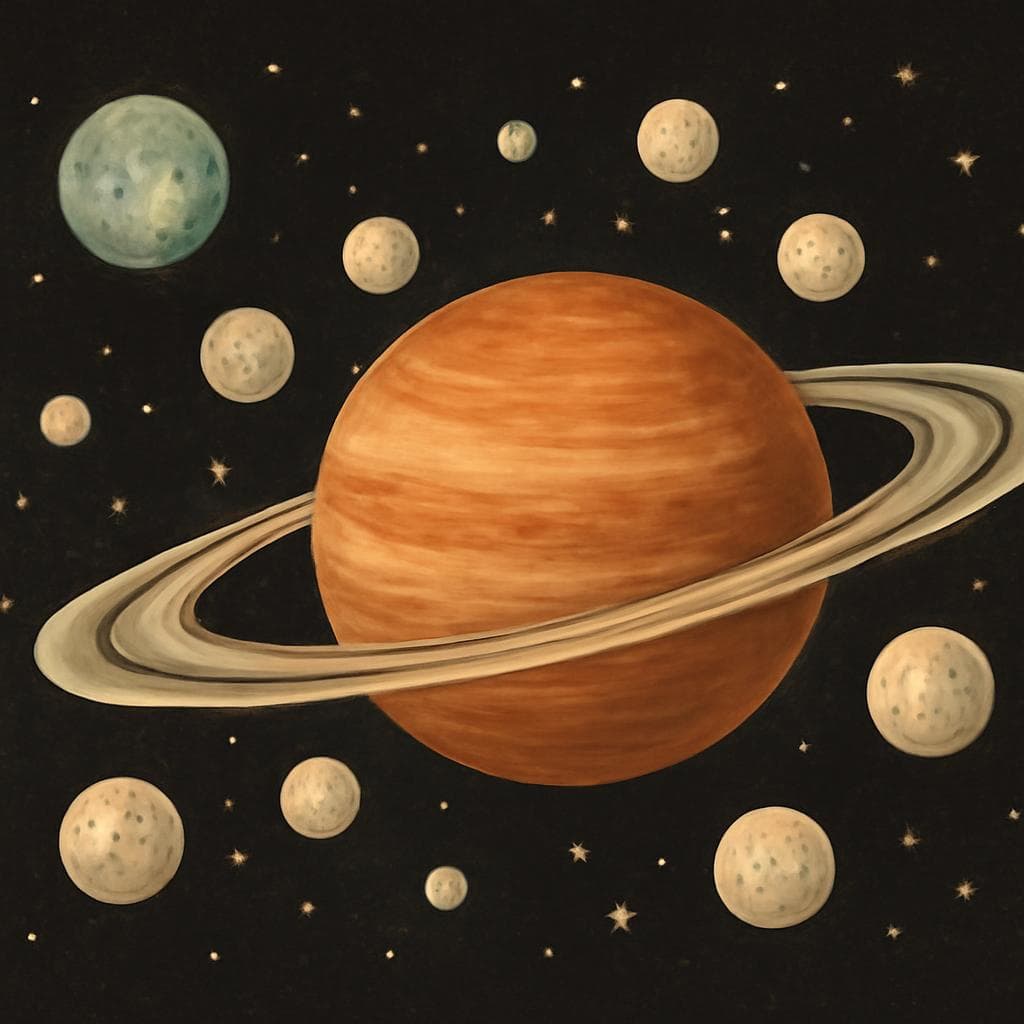
The Quiz Question
Which planet in our solar system has the most moons?
- A. Jupiter
- B. Saturn
- C. Uranus
- D. Neptune
The answer is B. Saturn. Here is the full story.
Saturn's Moon Collection Is Truly Out of This World
For years, Jupiter wore the crown as the planet with the most moons in our solar system. Then, in 2023, astronomers confirmed a staggering haul of newly discovered moons orbiting Saturn — pushing its total past 146 and firmly knocking Jupiter off its throne. Jupiter, for comparison, sits at around 95 confirmed moons. It's not even close anymore.
Why Does Saturn Have So Many Moons?
Saturn's massive gravitational pull is the short answer. The planet is enormous — about 95 times the mass of Earth — and that gravity acts like a cosmic net, capturing smaller rocky and icy objects that wander too close. Many of Saturn's newly confirmed moons are tiny, irregular bodies, likely fragments from larger objects that broke apart long ago, or ancient debris captured from the outer solar system.
Most of these smaller moons orbit in distant, tilted, and sometimes retrograde paths — meaning they travel backwards relative to Saturn's rotation. That's a telltale sign they were captured rather than formed alongside the planet.
The Famous Ones vs. The Tiny Newcomers
Not all of Saturn's moons are obscure chunks of rock. Titan is Saturn's largest moon and one of the most fascinating objects in the entire solar system. It has a thick atmosphere, lakes of liquid methane, and is considered a serious candidate in the search for extraterrestrial life. Enceladus is another standout — its icy surface conceals a subsurface ocean, and geysers near its south pole actively spray water ice into space.
The newly confirmed moons, on the other hand, are far less glamorous. Many are just a few kilometres across, detected only through powerful telescopes and careful observation over multiple nights to confirm their orbital paths. They don't yet have proper names — they're catalogued by temporary designations while astronomers work through the naming process.
How Do Scientists Even Find These Tiny Moons?
Finding a moon that's only a few kilometres wide orbiting a planet over a billion kilometres away is no small feat. Astronomers use large ground-based telescopes to take repeated images of the area around Saturn, then track faint moving points of light across those images. A moon has to be observed over a long enough arc of its orbit to confirm it's genuinely bound to Saturn and not just a passing asteroid.
The 2023 confirmations came largely from work by teams using telescopes in Hawaii and Chile, building on years of patient observation.
The Count Is Likely to Keep Rising
Here's the thing — 146 probably isn't the final number. As telescope technology improves, astronomers expect to find even more small, dim moons hiding in Saturn's vast gravitational neighbourhood. The ringed giant may be even more prolific than we currently know, and every new discovery adds another chapter to the remarkable story of our solar system's most moon-rich world.