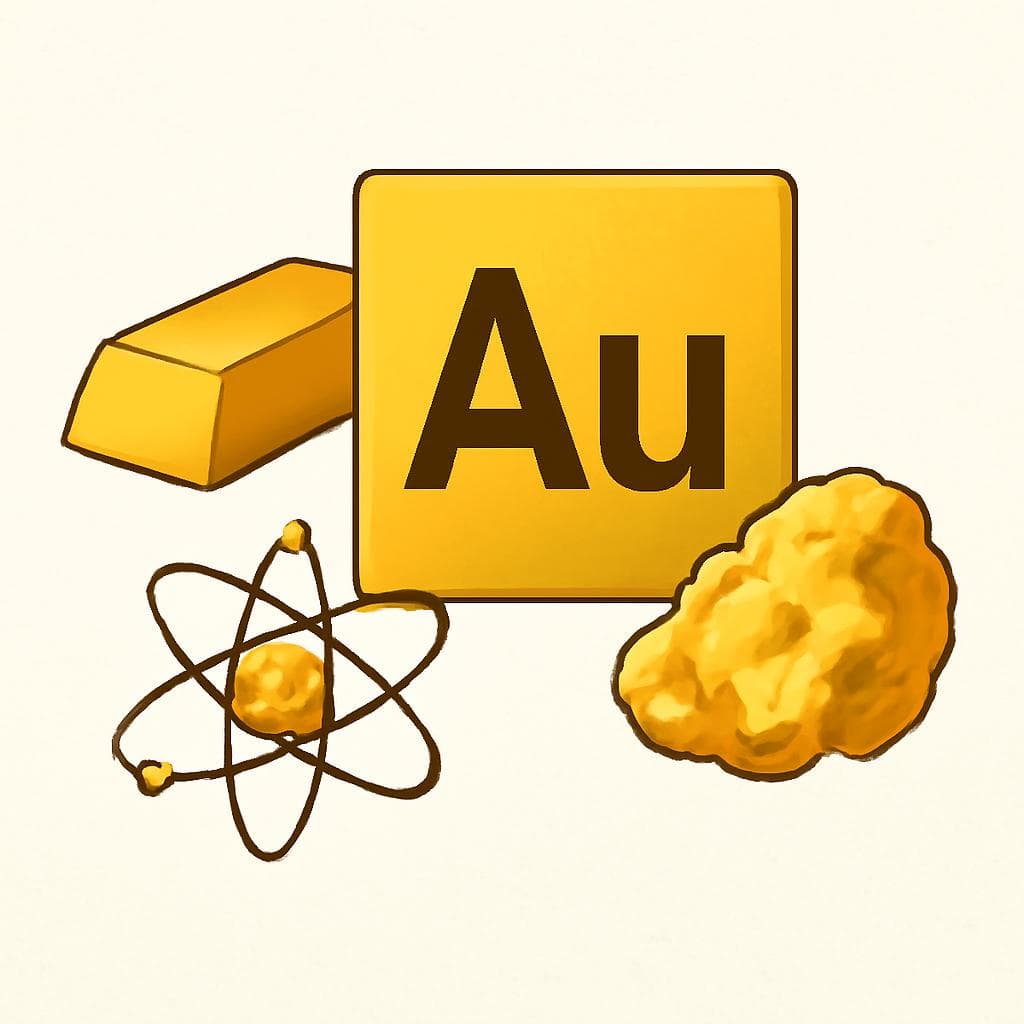
The Quiz Question
Which element has the chemical symbol 'Au'?
- A. Silver
- B. Aluminum
- C. Gold
- D. Argon
The answer is C. Gold. Here is the full story.
Gold's Secret Identity: Why 'Au' Has Nothing to Do With the Letter G
If you've ever glanced at a periodic table and wondered why gold doesn't go by 'Go' or even 'Gd', you're not alone. The symbol Au looks like it belongs to a completely different element — and in a way, it does. It belongs to gold's ancient past.
It All Starts in Ancient Rome
The symbol Au comes directly from aurum, the Latin word for gold. Roman civilization ran on the stuff — coins, jewellery, temples, trade. The word aurum itself is thought to derive from an even older Proto-Indo-European root connected to words meaning "dawn" or "glow," a nod to gold's warm, radiant colour. When early scientists began systematising chemistry in the 18th and 19th centuries, they leaned heavily on Latin, the international language of scholarship. Gold's Latin name stuck.
Gold Is Genuinely Ancient
Gold is one of the oldest metals known to humanity — worked and worshipped for at least 7,000 years. Unlike iron or copper, it doesn't rust, tarnish, or corrode. You can find pure gold nuggets just lying in riverbeds. That combination of beauty and near-indestructibility made it almost supernaturally appealing to every civilisation that encountered it.
Where Does Gold Actually Come From?
Here's where things get genuinely mind-bending. Most of Earth's gold was delivered by meteorite bombardment roughly 4 billion years ago. Before that, the heavy metal had largely sunk to the planet's core. But the gold we mine today? It originally formed inside dying stars and neutron star collisions — a violent cosmic process called the r-process (rapid neutron capture). Every gold ring or filling you've ever seen is, quite literally, stardust forged in a stellar catastrophe.
Au Isn't the Only Symbol That Looks 'Wrong'
Gold is in good company when it comes to unexpected chemical symbols. Silver is Ag (from Latin argentum), iron is Fe (ferrum), and lead is Pb (plumbum — also the root of the word "plumber"). These symbols are linguistic fossils, preserving the Latin names that dominated European science for centuries.
Gold by the Numbers
On the periodic table, gold sits at atomic number 79, meaning each gold atom has 79 protons in its nucleus. It's a transition metal, dense enough that a cubic foot of it weighs around half a tonne. It's also extraordinarily malleable — one gram can be beaten into a sheet covering roughly a square metre.
Still Valuable, Still Fascinating
Whether it's underpinning global economies, conducting electricity in your smartphone, or being tracked in the cosmos by gravitational wave detectors, gold remains one of the most scientifically and culturally significant elements on Earth. And every time you see that little symbol Au, you're reading two thousand years of human history in just two letters.