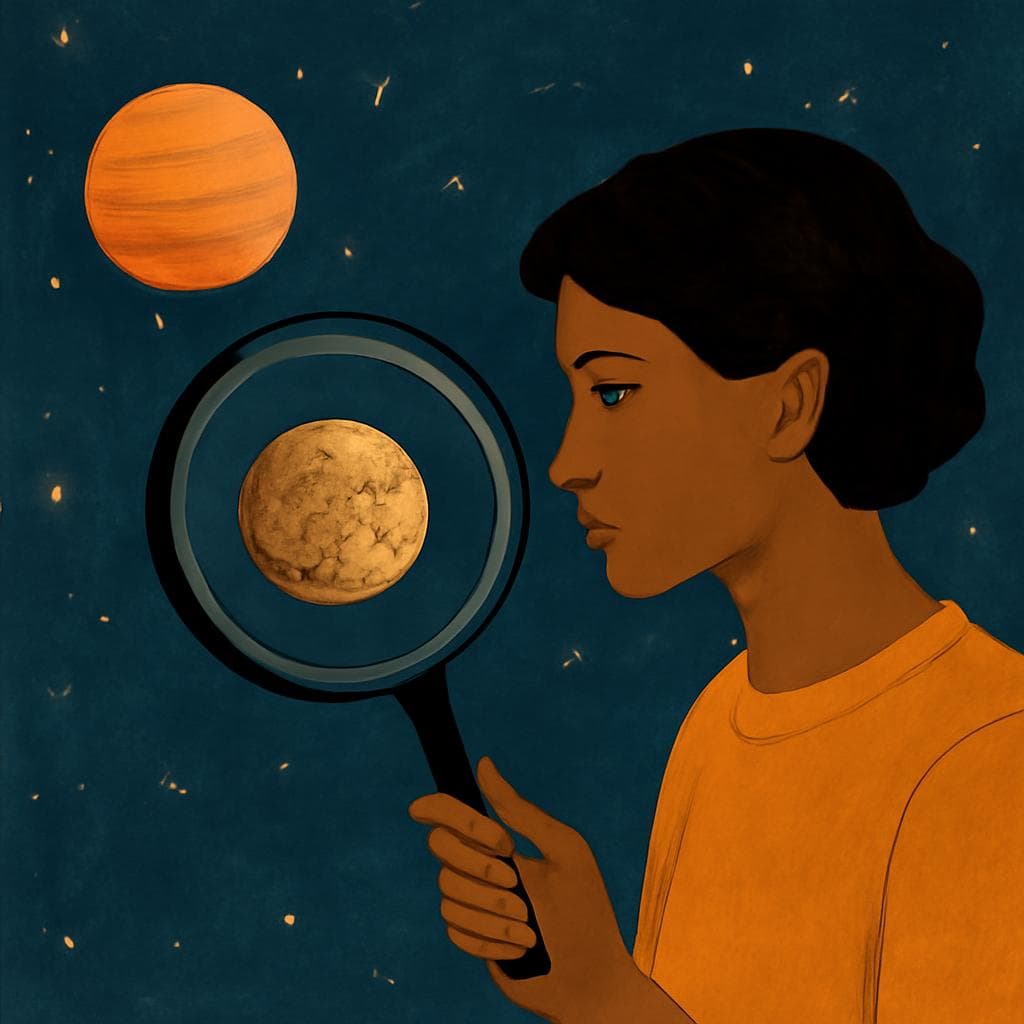
The Quiz Question
What is the smallest planet in our solar system?
- A. Mars
- B. Mercury
- C. Venus
- D. Pluto
The answer is B. Mercury. Here is the full story.
Mercury: The Solar System's Mighty Little World
It might be the closest planet to the Sun, but Mercury is also the smallest of all eight planets — and it's not particularly close. With a mean diameter of just 4,879 kilometres (about 3,032 miles), Mercury is roughly 40% the size of Earth. You could fit Mercury inside Earth nearly 18 times over.
How Small Are We Talking?
To put it in perspective, Mercury is actually smaller than two of the moons in our solar system — Jupiter's Ganymede and Saturn's Titan. Both of those moons would dwarf Mercury if you placed them side by side. Yet because Ganymede and Titan orbit other planets rather than the Sun directly, Mercury still holds the title of smallest planet.
It's also worth noting that Pluto — the runner-up in most people's minds — was reclassified as a dwarf planet by the International Astronomical Union back in 2006. At roughly 2,377 km in diameter, Pluto is actually less than half the size of Mercury, but its demotion means it no longer competes for the title.
A Dense Little Powerhouse
Don't let the small size fool you. Mercury is extraordinarily dense, ranking second only to Earth in density among the planets. Scientists believe it has an oversized iron core that makes up roughly 85% of its radius — a far higher proportion than any other planet. One leading theory suggests a massive ancient collision stripped away much of Mercury's outer rocky mantle billions of years ago, leaving behind that heavy metallic interior.
A World of Extremes
Mercury's small size comes with some dramatic consequences. It has virtually no atmosphere to speak of — just a wispy exosphere made of atoms blasted off its surface by solar wind. Without a thick atmosphere to regulate temperature, Mercury experiences some of the most extreme temperature swings in the solar system. Surface temperatures can soar to 430°C (800°F) during the day, then plummet to -180°C (-290°F) at night.
Bizarrely, despite being the closest planet to the Sun, Mercury is not the hottest. That title belongs to Venus, whose thick carbon dioxide atmosphere traps heat in a runaway greenhouse effect.
What We've Learned Up Close
NASA's MESSENGER spacecraft orbited Mercury from 2011 to 2015, giving us our best detailed maps of the surface. It confirmed ancient volcanic plains, massive cliff-like scarps formed as the planet's core cooled and shrank, and — surprisingly — water ice hiding in permanently shadowed craters near the poles. The ESA/JAXA BepiColombo mission is currently en route and is expected to enter orbit around 2025, promising to reveal even more secrets about this compact, battered, fascinating world.
Small in size, but absolutely not short on surprises.