The Quiz Question
What is the largest planet in our solar system?
The answer is Jupiter. Here is the full story.
Jupiter: The Solar System's Gentle Giant
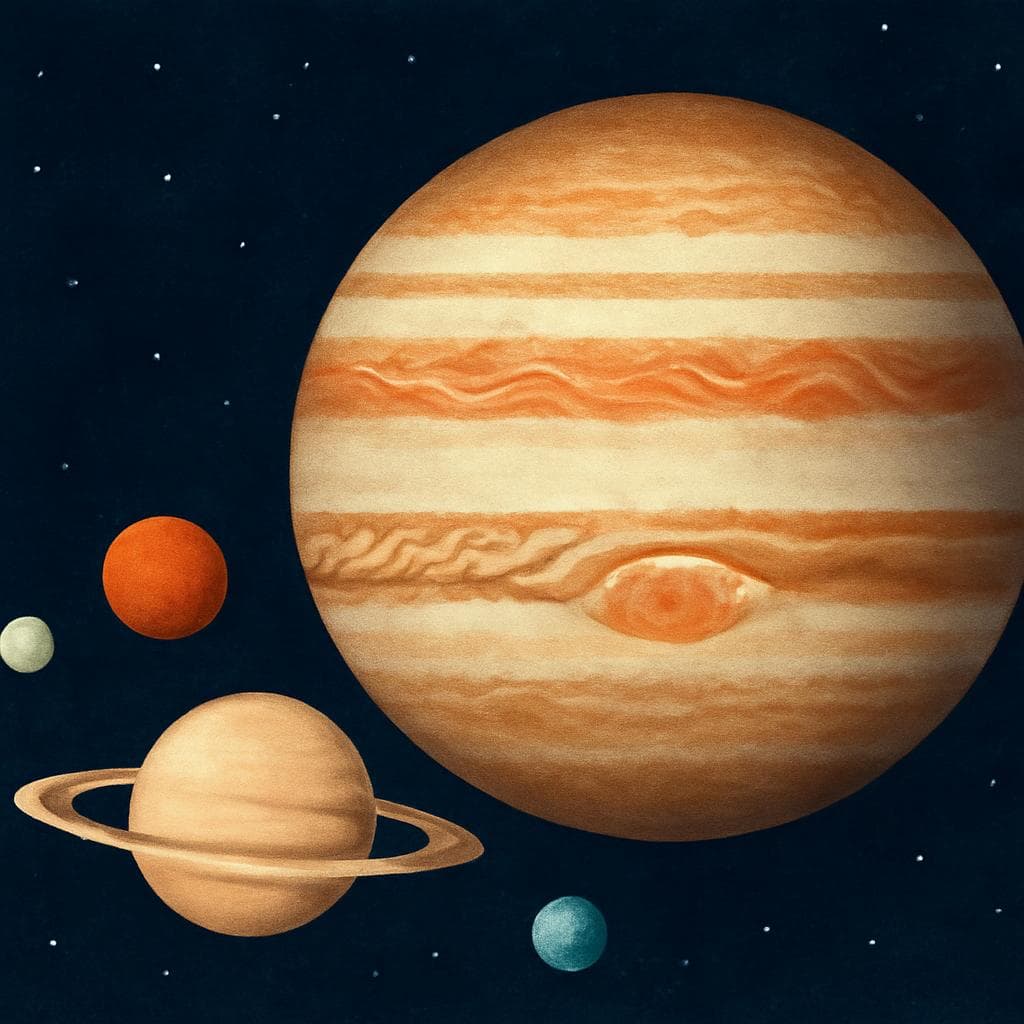
When it comes to sheer size, nothing in our solar system comes close to Jupiter. This colossal gas giant is so massive that all the other planets could fit inside it — combined — with room to spare. It has a volume roughly 1,321 times that of Earth, and a mass more than twice that of every other planet in the solar system put together.
Just How Big Are We Talking?
Jupiter's diameter clocks in at about 139,820 kilometres — more than 11 times the width of Earth. If Earth were the size of a grape, Jupiter would be the size of a basketball. Its Great Red Spot alone — a storm that has been raging for at least 350 years — is wider than Earth itself, though scientists have observed it slowly shrinking over recent decades.
What Is Jupiter Actually Made Of?
Despite its enormous size, Jupiter has no solid surface. It's classified as a gas giant, composed primarily of hydrogen and helium — the same basic ingredients as the Sun. Deep within its atmosphere, the pressure becomes so extreme that hydrogen is crushed into a liquid metallic state, a form of matter that doesn't exist naturally anywhere on Earth. At the very centre, there may be a dense rocky or metallic core, though scientists are still working to understand its exact composition.
A Planet Full of Records
Jupiter doesn't just win on size — it dominates in other ways too. It spins faster than any other planet, completing a full rotation in just under 10 hours, which causes it to bulge noticeably at its equator. It also has the strongest magnetic field of any planet, roughly 20,000 times more powerful than Earth's. And with 95 known moons as of 2023, it has the largest retinue of natural satellites in the solar system. Its four largest — Io, Europa, Ganymede, and Callisto — were discovered by Galileo in 1610 and are known as the Galilean moons.
Jupiter as a Cosmic Shield
There's a compelling theory among planetary scientists that Jupiter's immense gravitational pull has played a role in protecting the inner solar system — including Earth — from frequent comet and asteroid impacts. By acting as a kind of gravitational vacuum cleaner, it pulls dangerous debris toward itself or flings it out of the solar system entirely. We witnessed this dramatically in 1994 when Comet Shoemaker-Levy 9 broke apart and slammed into Jupiter in a series of spectacular collisions.
Still Being Explored
NASA's Juno spacecraft has been orbiting Jupiter since 2016, sending back breathtaking images and invaluable data about its atmosphere, magnetic field, and interior. The mission continues to reshape our understanding of how Jupiter — and by extension, our entire solar system — formed and evolved. For a planet we've known about since antiquity, Jupiter still has plenty of surprises left to offer.