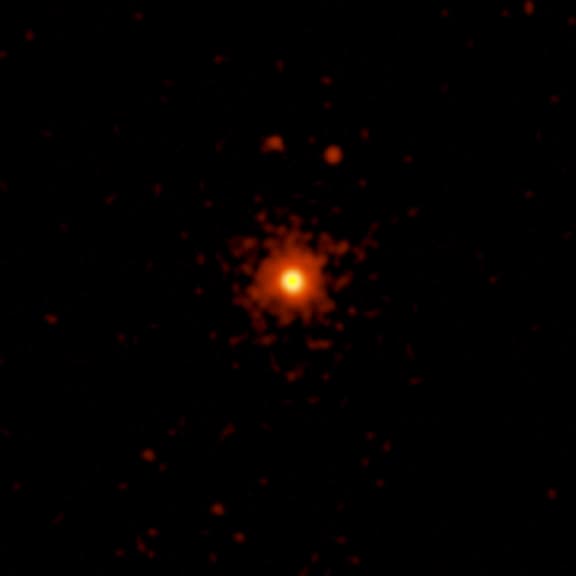
The Quiz Question
What is the closest star to Earth other than the Sun?
- A. Sirius
- B. Alpha Centauri
- C. Proxima Centauri
- D. Betelgeuse
The answer is C. Proxima Centauri. Here is the full story.
Our Nearest Stellar Neighbor
At just 4.24 light-years from Earth, Proxima Centauri holds the title of our closest stellar neighbor beyond the Sun. That distance sounds manageable until you do the math — traveling there at the speed of a typical spacecraft would take tens of thousands of years. Space is big. Really big.
Part of a Triple-Star Family
Proxima Centauri doesn't travel alone. It's part of the Alpha Centauri system, a trio of stars bound together by gravity. The other two — Alpha Centauri A and Alpha Centauri B — are a closely paired duo that orbit each other, and together they appear as one of the brightest points of light in the southern sky. Proxima is the odd one out: a dim, distant companion orbiting far from the central pair, taking somewhere around 550,000 years to complete a single lap around them.
Small, Red, and Extraordinarily Long-Lived
Proxima Centauri is a red dwarf — a category of star that is far smaller, cooler, and dimmer than our Sun. Its surface temperature sits around 3,000 Kelvin, compared to the Sun's roughly 5,800 Kelvin. With the naked eye, you can't see it at all from Earth. Despite its modest size, red dwarfs like Proxima are actually the most common type of star in the Milky Way, and they burn their fuel so slowly that they can live for trillions of years — far outlasting the Sun's expected 10-billion-year lifespan.
A Planet in the Habitable Zone
Here's where things get genuinely exciting. In 2016, astronomers confirmed the existence of Proxima Centauri b, a planet orbiting within the star's habitable zone — the region where liquid water could theoretically exist on a planet's surface. It's roughly Earth-sized and orbits its star every 11.2 days. Whether it could actually support life is a much harder question. Red dwarfs are prone to violent stellar flares that could strip away a planet's atmosphere, and being that close to the star raises questions about radiation levels and tidal locking.
The Target of Future Exploration
Proxima Centauri has become the focal point of some genuinely ambitious space exploration concepts. The Breakthrough Starshot initiative, backed by physicist Stephen Hawking before his death and entrepreneur Yuri Milner, proposed sending a fleet of tiny, laser-propelled probes toward the Alpha Centauri system at roughly 20% the speed of light. At that pace, they'd arrive in about 20 years. It remains theoretical for now, but the fact that scientists are seriously designing missions to our nearest stellar neighbor shows just how central Proxima Centauri has become to our imagination of what lies beyond our own solar system.