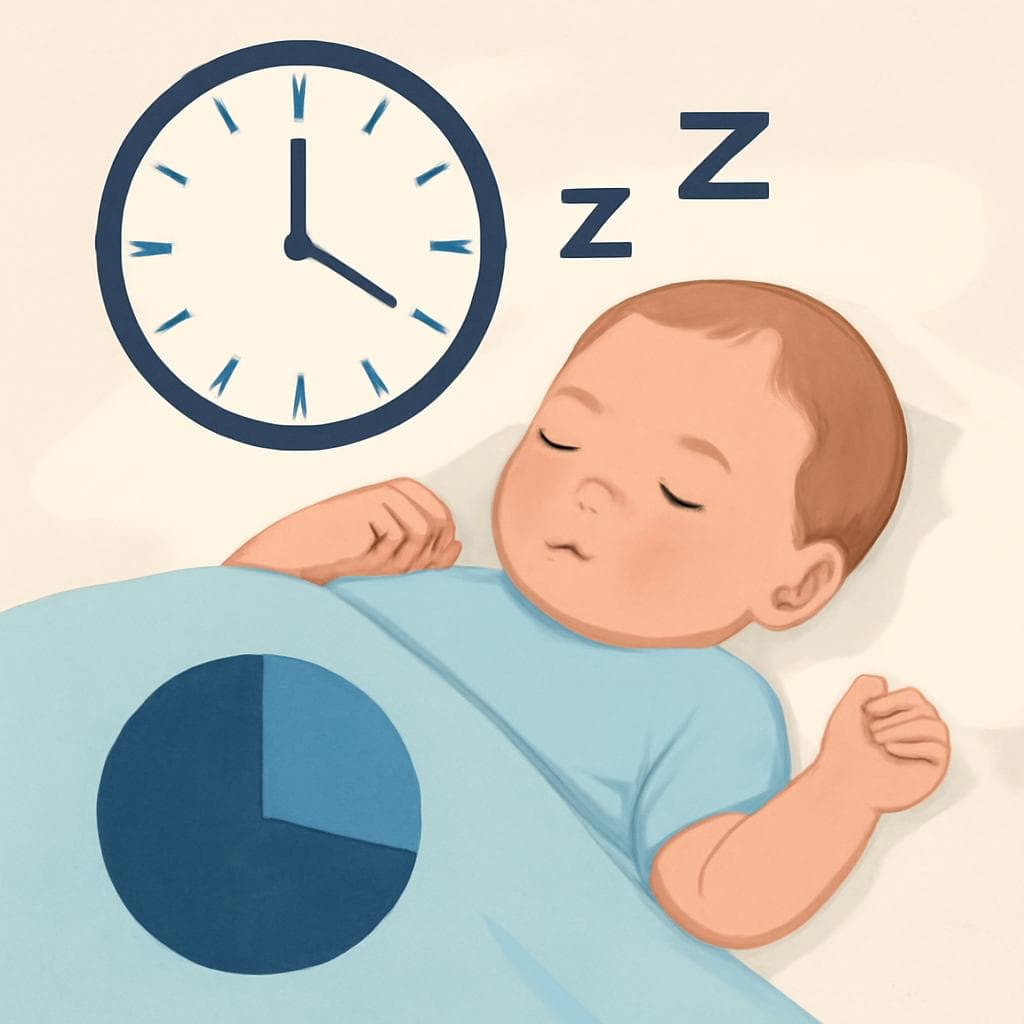
The Quiz Question
On average, how many hours a day do newborns sleep?
- A. 6-8 hours
- B. 10-12 hours
- C. 14-17 hours
- D. 20-22 hours
The answer is C. 14-17 hours. Here is the full story.
Why Newborns Spend So Much Time Asleep
If you've ever spent time around a newborn, you've probably noticed they seem to do little else but eat, cry, and sleep. That last one takes up a surprising chunk of the day — somewhere between 14 and 17 hours out of every 24. That's not laziness. That's biology doing some of its most important work.
The Sleeping, Growing Brain
A newborn's brain roughly doubles in size during the first year of life. Sleep is the engine driving that growth. During sleep — particularly active sleep, which in adults we'd call REM — a baby's brain is buzzing with activity, forming the neural connections that will eventually support language, memory, emotion, and movement.
In fact, newborns spend about 50% of their sleep in this active, REM-like state, compared to around 20% for adults. Scientists believe this intense dreaming phase is directly linked to early brain development. The sleeping baby might look peaceful, but underneath, there's a construction project going on at full speed.
Growth Hormone Does Its Best Work at Night
It's not just the brain that benefits. Human growth hormone is released primarily during deep sleep. For a baby that needs to triple its birth weight in the first year, that hormonal surge matters enormously. Sleep isn't downtime — it's when the body manufactures the building blocks of a bigger, stronger infant.
Why It Comes in Scattered Bursts
Don't be fooled by those impressive total hours. Newborns don't clock a solid 15-hour block at night. Their sleep arrives in short stretches of two to four hours, scattered across the full 24-hour day. That's because newborns haven't yet developed a circadian rhythm — the internal body clock that tells older humans when to sleep and when to wake.
Circadian rhythms are driven partly by light exposure and partly by the hormone melatonin. Newborns produce very little melatonin at first, and their systems haven't yet learned to sync up with the day-night cycle. That usually starts to click into place somewhere around three to six months of age — which is also when many parents finally start to get a decent night's rest themselves.
What the Experts Recommend
The National Sleep Foundation sets the recommended range at 14 to 17 hours per day for newborns (defined as babies from birth to three months old). Some babies sleep as many as 19 hours without any cause for concern, while others manage fine on 11 to 13. The exact number varies by individual, just as it does with adults.
What matters more than hitting a precise number is the quality and safety of the sleep environment — firm mattress, no loose bedding, and placing the baby on their back every time.
Sleep Is the Real Work of Infancy
Next time someone jokes that a baby "has it easy," consider what's actually happening during all that sleep. Neural circuits are wiring up, immune defenses are strengthening, and a tiny body is building itself from scratch. Fourteen to seventeen hours a day turns out to be exactly the right amount of time for all of that.