The Quiz Question
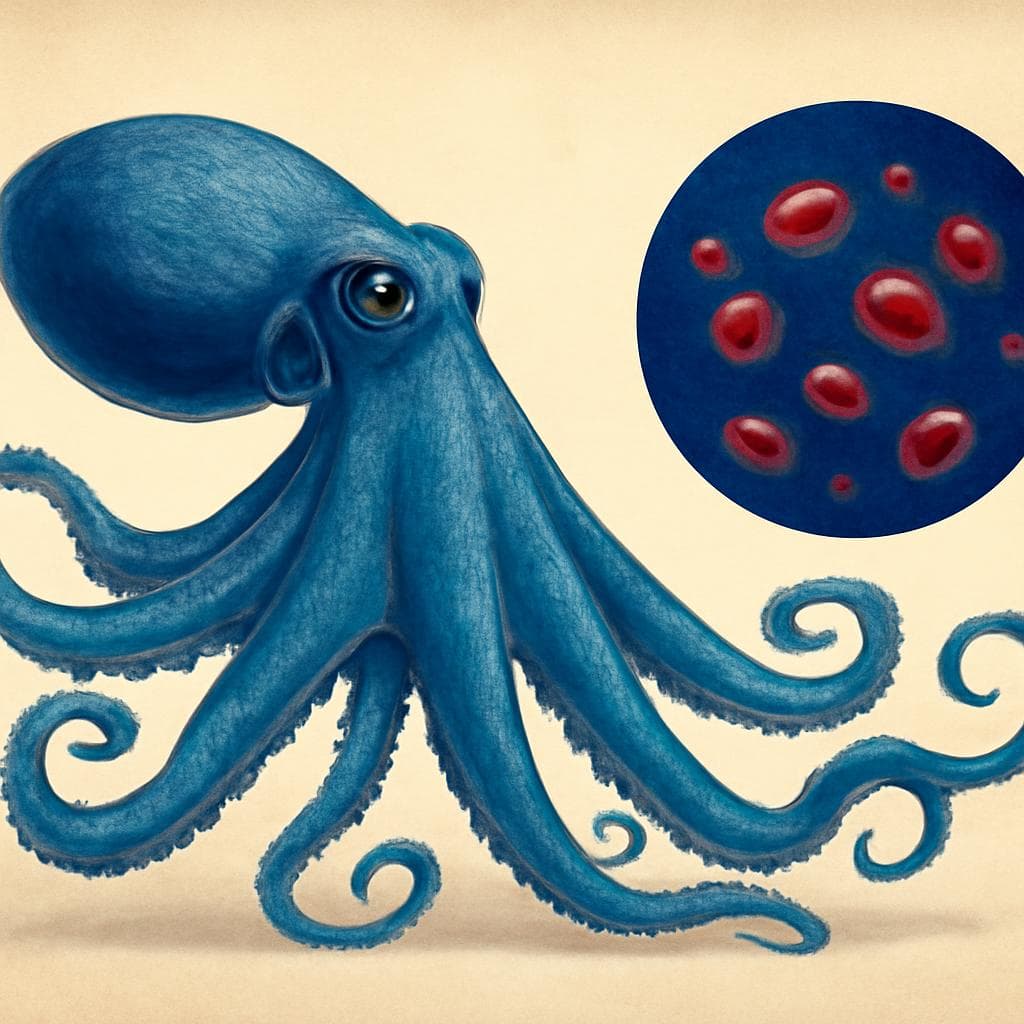
Octopuses have blue blood.
- A. True
- B. False
- C. Only in cold water
- D. Only when threatened
The answer is A. True. Here is the full story.
Why Octopus Blood Is Blue
If you ever cut yourself, you know human blood runs red. But crack open the biology of an octopus and you'll find something straight out of science fiction — vivid, blue-tinted blood coursing through its body. This isn't a quirk or a fluke. It's a elegant evolutionary solution to a very specific problem.
It All Comes Down to Copper
Human blood is red because it uses hemoglobin to carry oxygen — a protein built around iron atoms. When iron binds to oxygen, it produces that familiar red color. Octopuses took a completely different evolutionary path. Their blood uses a molecule called hemocyanin, which is built around copper atoms instead of iron.
When hemocyanin picks up oxygen, the copper reacts and the blood turns a striking blue. When it releases that oxygen to the tissues, the color fades to a near-colorless pale grey. The blue you see is literally the color of an octopus breathing.
Why Copper Instead of Iron?
It's not a random choice — hemocyanin works exceptionally well in cold, low-oxygen environments like the deep ocean. Copper-based molecules are more efficient at grabbing and releasing oxygen under those specific conditions. For creatures living in chilly, oxygen-sparse waters, hemocyanin gives a real survival advantage over iron-based systems.
The trade-off is that hemocyanin is less efficient than hemoglobin at warmer temperatures and higher oxygen levels. That's one reason you don't see copper-based blood in mammals running around on land. Evolution picks the tool that fits the environment.
They're Not Alone
Octopuses aren't the only blue-blooded animals on the planet. Crabs, lobsters, horseshoe crabs, spiders, and many other arthropods and mollusks also rely on hemocyanin. In fact, horseshoe crab blood — famously expensive and medically valuable — is blue for exactly the same reason.
Horseshoe crab blood is harvested by pharmaceutical companies because it contains a compound called Limulus Amebocyte Lysate (LAL), which is uniquely sensitive to bacterial toxins. Nearly every injectable drug or vaccine you've ever received was tested using it. Blue blood, it turns out, has saved millions of human lives.
Three Hearts, Three Blood Colors?
Here's one more layer to appreciate: octopuses have three hearts. Two pump blood to the gills, and one pumps it to the rest of the body. That blue, copper-rich blood moves through a completely open circulatory system — meaning it doesn't stay neatly inside vessels the whole time, but bathes the organs directly in some areas.
So next time you admire an octopus in an aquarium, remember you're looking at an animal with alien-blue blood, three hearts, and a circulatory chemistry that evolution cooked up hundreds of millions of years ago. Nature really doesn't need to stick to one recipe.