The Quiz Question
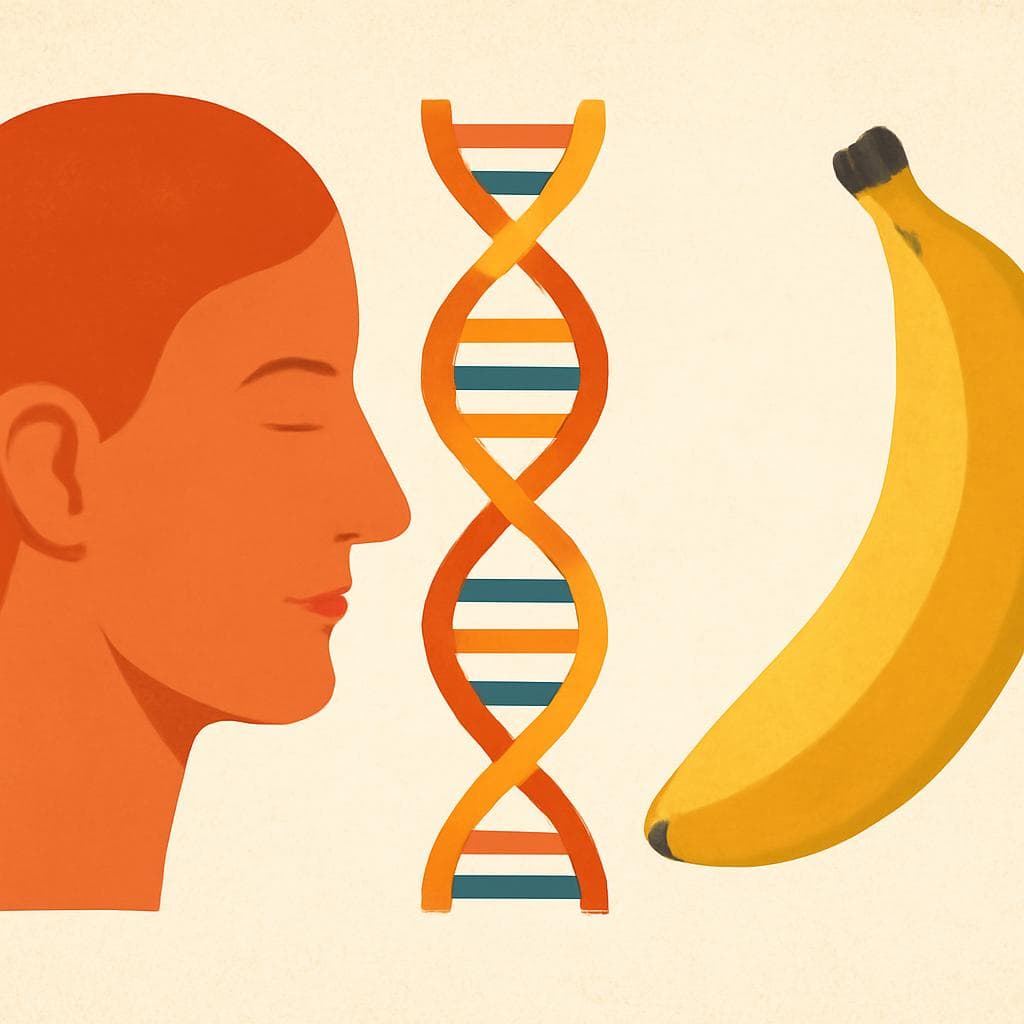
Humans share about 60% of their DNA with bananas.
- A. True
- B. False
- C. Closer to 5%
- D. Closer to 95%
The answer is A. True. Here is the full story.
You Really Do Share DNA With a Banana
It sounds like the setup to a bad joke, but the science is genuine. Humans and bananas share roughly 50 to 60 percent of their genes — and that surprising statistic reveals something profound about the nature of life on Earth.
Why So Much Overlap?
The genes we share with bananas aren't the ones that make us walk upright or write poetry. They're the deep, ancient instructions that keep any living cell running. Things like replicating DNA, converting food into energy, and managing cell division. These biological processes are so fundamental — and so difficult to improve upon — that evolution has conserved them across billions of years and wildly different organisms.
Think of it like plumbing. A hospital and a garden shed are completely different buildings, but both still need pipes that carry water the same basic way. Bananas and humans are extraordinarily different organisms, but we both need cells that function, divide, and produce energy. The instructions for doing that look remarkably similar at the genetic level.
What Does "Sharing Genes" Actually Mean?
It's worth being precise here. When scientists say we share roughly 60 percent of our genes with bananas, they mean that about 60 percent of human gene families have a functional counterpart in the banana genome. The sequences aren't identical, but the underlying purpose is recognizably the same. A gene that manages cellular respiration in you serves a similar role in a banana plant.
This is different from saying 60 percent of your DNA strand is a letter-for-letter match with banana DNA. The similarity is functional and structural — about shared biological roles, not identical code.
The Bigger Picture
The banana comparison is striking precisely because bananas seem so alien to us. But consider some other figures: humans share about 85 percent of their genes with a mouse, around 96 percent with chimpanzees, and roughly 31 percent with yeast. The further back in evolutionary history you go to find a common ancestor, the lower the number drops — but it never hits zero, because all life on Earth shares the same ancient molecular toolkit.
This is one of the most compelling pieces of evidence for evolution. The fact that a fruit and a human being both rely on overlapping genetic machinery points to a common origin billions of years ago, when the first cells developed the basic chemistry of life.
A Humbling Thought
Next time you eat a banana, you're consuming something that shares a meaningful chunk of its genetic blueprint with you. The universe is under no obligation to arrange things so that all life is related, and yet here we are — deeply connected at the molecular level to everything from fungi to fruit trees. Biology has a way of making the world feel simultaneously stranger and more wonderful.