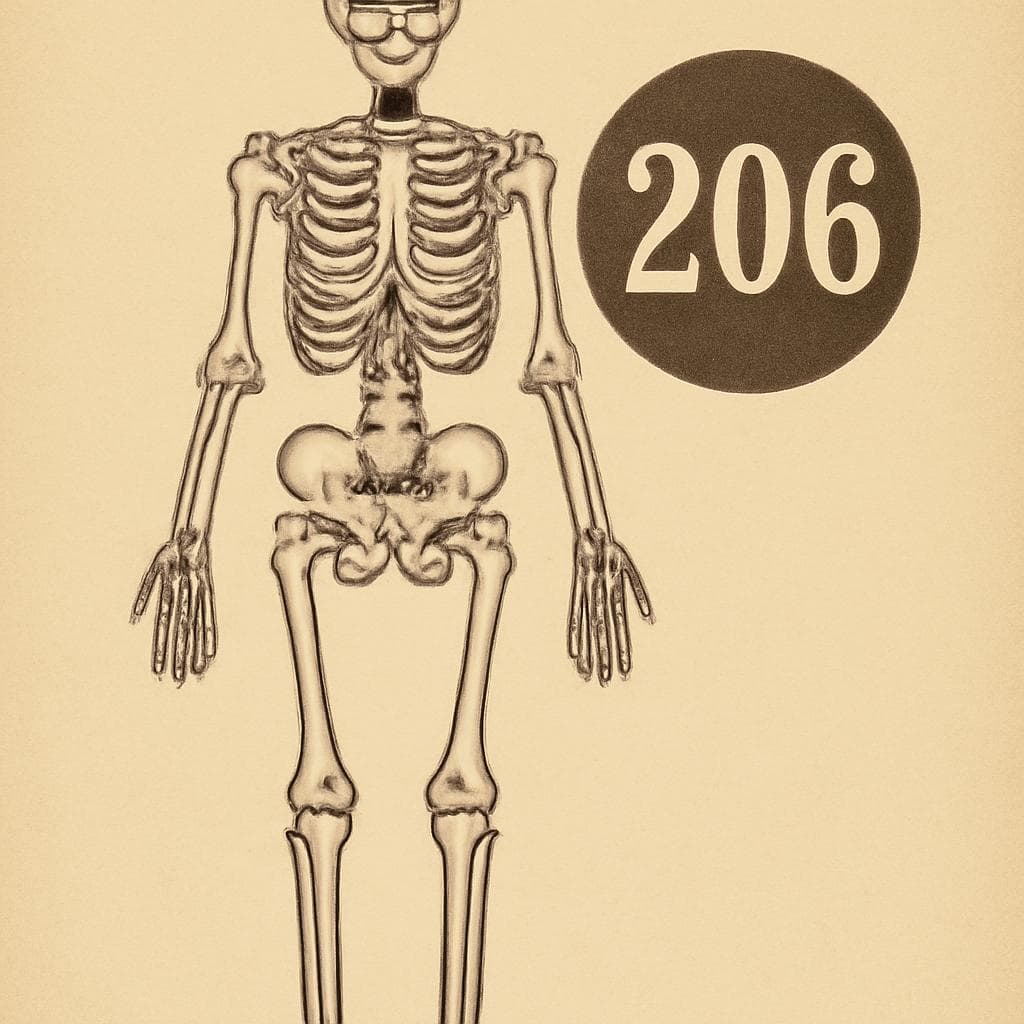
The Quiz Question
How many bones are in the adult human body?
- A. 206
- B. 198
- C. 212
- D. 200
The answer is A. 206. Here is the full story.
Why 206? The Surprising Story Behind the Human Skeleton
You were born with around 270 to 300 bones in your body. By the time you reach adulthood, that number has dropped to 206. No, you didn't lose any — they fused together. It's one of the more quietly remarkable things your body does without you noticing.
The Great Bone Merger
During childhood and adolescence, many bones that start out as separate pieces gradually fuse into single, solid structures. The skull is a prime example — at birth, it's made up of several unfused plates (those soft spots you might have felt on a baby's head, called fontanelles, sit right between them). Over the first couple of years of life, those plates knit together into the hard, protective dome we know in adults.
The last bones to fully fuse are typically the clavicles (collarbones) and the bones at the ends of your long bones, called epiphyses. This process wraps up somewhere in your mid-twenties, which is one reason doctors use bone development as a marker of biological age.
Breaking Down the 206
Those 206 bones aren't distributed evenly. More than half of them — 106, to be precise — are found in just your hands and feet. The hand alone contains 27 bones; the foot contains 26. That concentration of small, intricate bones is what gives your hands the dexterity to thread a needle and your feet the flexibility to walk on uneven terrain.
The rest of the skeleton handles the big structural jobs: the axial skeleton (skull, vertebral column, and rib cage) counts 80 bones and protects your brain, spinal cord, and vital organs. The appendicular skeleton — arms, legs, shoulder girdle, and pelvis — makes up the remaining 126 and handles movement.
The 206 Rule Has Exceptions
Here's where it gets interesting: 206 is the standard number, but not a universal one. Some people are born with extra bones called sesamoid bones (the patella, or kneecap, is actually the body's largest sesamoid bone) or small accessory bones in the feet and skull called Wormian bones. These extras are fairly common and don't cause any problems — they're just anatomical quirks.
On the flip side, some people have one fewer lumbar vertebra, or fused vertebrae, that bring their count slightly below 206. The number is a reliable average, not an ironclad rule.
Bone Is Anything But Static
It's easy to think of the skeleton as a fixed, permanent scaffold, but bone is living tissue. It's constantly being broken down and rebuilt in a process called remodeling. Your entire skeleton is essentially replaced roughly every decade. Bone cells called osteoclasts dissolve old bone material, while osteoblasts lay down new tissue in its place.
So those 206 bones aren't the same ones you had ten years ago — they just follow the same blueprint.