The Quiz Question
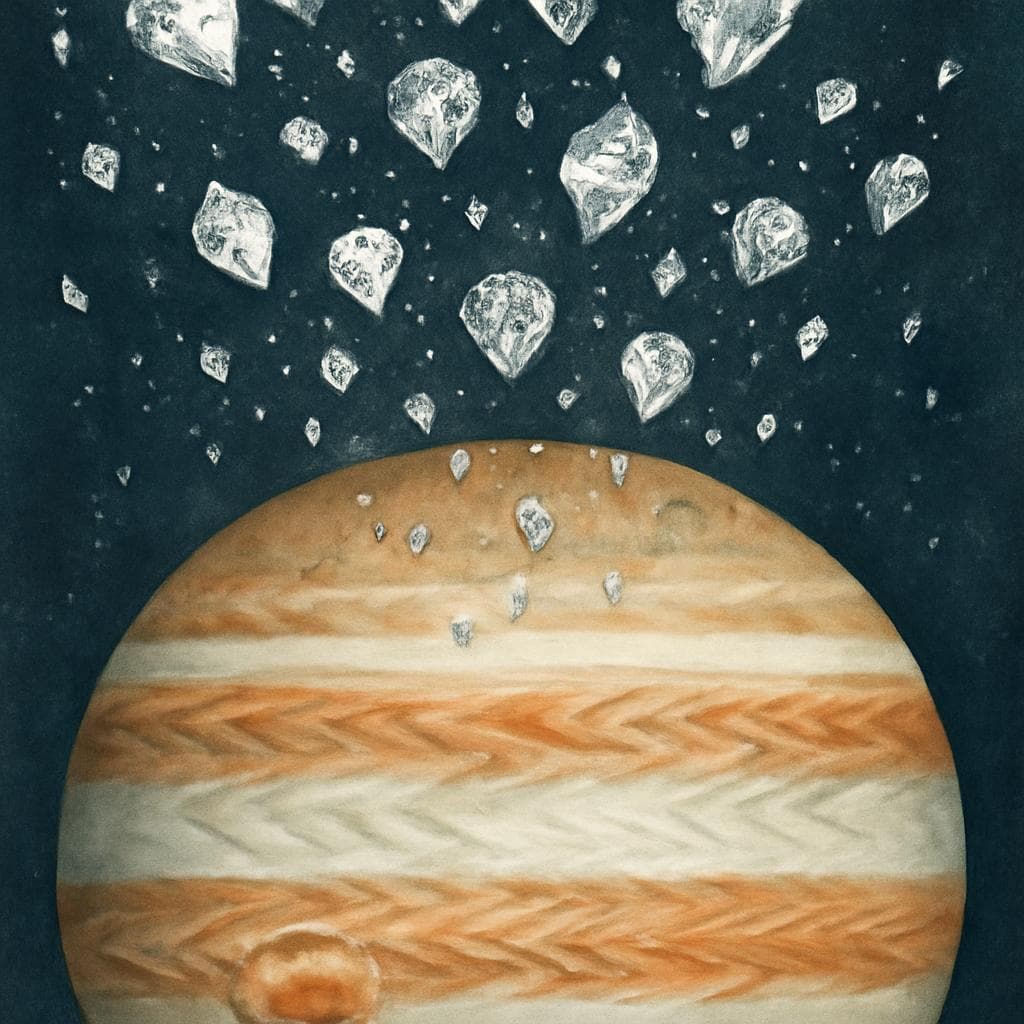
Diamonds rain on Jupiter
- A. True
- B. False
- C. Only Saturn
- D. Unknown
The answer is A. True. Here is the full story.
It Really Does Rain Diamonds on Jupiter
It sounds like pure science fiction, but the physics checks out. Deep inside Jupiter's atmosphere, conditions exist that can literally transform carbon into diamond crystals and send them plunging toward the planet's core. Scientists at NASA and planetary research institutions have been building the case for this extraordinary phenomenon for decades.
How the Process Begins
Jupiter's upper atmosphere contains methane gas. When powerful lightning storms — far more intense than anything we experience on Earth — strike this methane, they break apart the carbon-hydrogen bonds. The freed carbon atoms clump together into tiny particles of soot, essentially pure carbon in its most basic form.
As that soot falls deeper into the atmosphere, the pressure and temperature increase dramatically. About 6,000 kilometres down, conditions squeeze and heat the carbon just enough to turn it into graphite. Keep falling another few thousand kilometres, and pressure climbs to around 1.4 million times the atmospheric pressure we feel at sea level. At that point, the graphite crystallises into diamond.
The Numbers Are Staggering
Planetary scientist Mona Delitsky and Kevin Baines of the University of Wisconsin-Madison presented detailed research on this in 2013 at a meeting of the American Astronomical Society's Division for Planetary Sciences. Their estimates suggested that roughly 1,000 tonnes of diamonds could be forming inside Jupiter every single year. The individual crystals, they calculated, might reach up to a centimetre in diameter — small, but unmistakably real gemstones falling like rain.
Where Do the Diamonds End Up?
Here is where things get even stranger. Jupiter does not have a solid surface. The deeper you go, pressure eventually becomes so extreme that even solid diamond cannot survive. Around 30,000 to 40,000 kilometres beneath the cloud tops, temperatures soar above 8,000°C. At that depth, the diamonds almost certainly melt into liquid carbon, joining what researchers believe may be a vast ocean of liquid metallic materials at the planet's core.
So Jupiter's diamonds are not sitting around waiting to be collected. They form, fall, and dissolve in a continuous cycle driven by the planet's immense gravitational grip.
Jupiter Is Not Alone
The same process is thought to occur on Saturn, which has a similar atmospheric composition and comparable storm activity. Uranus and Neptune are considered even better candidates, as their interiors contain enormous reservoirs of carbon under extreme pressure — leading some researchers to describe them as planets with diamond cores or even diamond oceans.
Our solar system turns out to be far more extravagant than anyone once imagined. The rarest gemstone on Earth is, somewhere out there in the gas giants, just another form of weather.