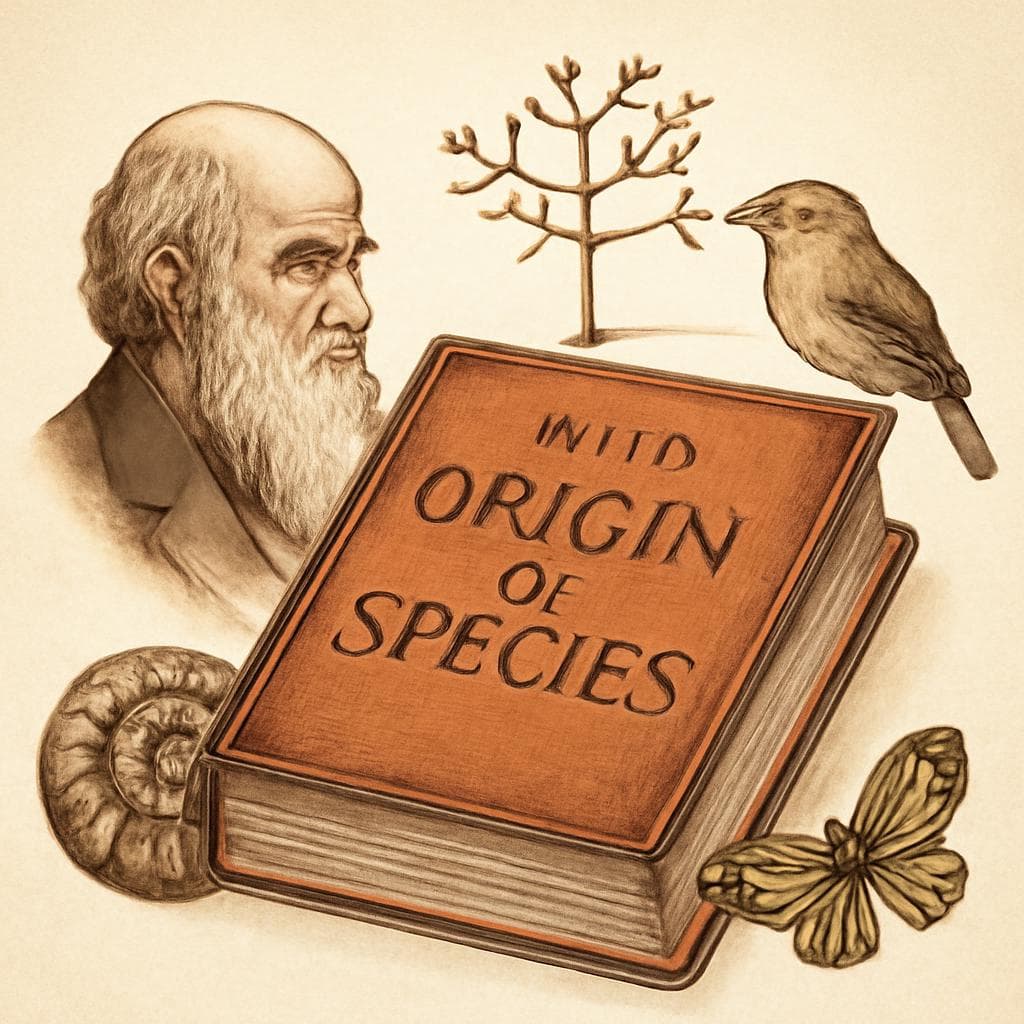
The Quiz Question
Darwin's famous book on evolution was published in what year?
The answer is 1859. Here is the full story.
The Book That Changed Everything
On November 24, 1859, Charles Darwin unleashed one of the most consequential ideas in the history of human thought. On the Origin of Species by Means of Natural Selection hit the shelves of London bookseller John Murray — and every single copy sold out on the very first day.
Twenty Years in the Making
Darwin hadn't rushed into print. He first sketched out his theory of natural selection back in 1838, after returning from his legendary five-year voyage aboard HMS Beagle. He spent the next two decades quietly gathering evidence, breeding pigeons, studying barnacles, and corresponding with naturalists around the world. He was famously cautious — even anxious — about how his ideas would land.
What finally pushed him to publish? A letter from Alfred Russel Wallace in 1858. Wallace, working independently in the Malay Archipelago, had arrived at almost exactly the same theory. Faced with being scooped, Darwin moved fast. He compressed years of planned writing into a single, readable volume he called an "abstract" of his larger work. That abstract turned out to be 502 pages long.
What the Book Actually Said
The central argument was elegantly simple: living things produce more offspring than can survive, individuals vary in their traits, and those with useful variations are more likely to survive and reproduce. Over vast stretches of time, this process — natural selection — shapes species, splits lineages, and can explain the stunning diversity of life on Earth.
Crucially, the 1859 edition barely mentioned human evolution at all. Darwin saved that for a later book, The Descent of Man, published in 1871. He knew the human angle would be the most explosive part, and he wanted his core mechanism established first.
The Reaction Was Immediate and Fierce
Within months, the book sparked one of the most famous debates in scientific history. In June 1860, at a meeting of the British Association in Oxford, biologist Thomas Huxley — known as "Darwin's Bulldog" — clashed with Bishop Samuel Wilberforce in a verbal duel that became the stuff of legend. The Church felt threatened; much of the scientific establishment was electrified.
Not everyone was hostile, though. Many scientists recognized immediately that Darwin had provided something biology had desperately lacked: a unifying mechanism to explain the patterns they had been observing for decades.
Why 1859 Still Matters
Six editions of the book appeared during Darwin's lifetime, each refined and updated as new evidence and criticism rolled in. Today, evolutionary biology underpins medicine, agriculture, conservation, and our understanding of disease. Every time a doctor tracks how a virus mutates, Darwin's framework is quietly at work.
The year 1859 didn't just mark the publication of a book. It marked the moment science got a new lens through which to see all of life — and it has never looked the same since.