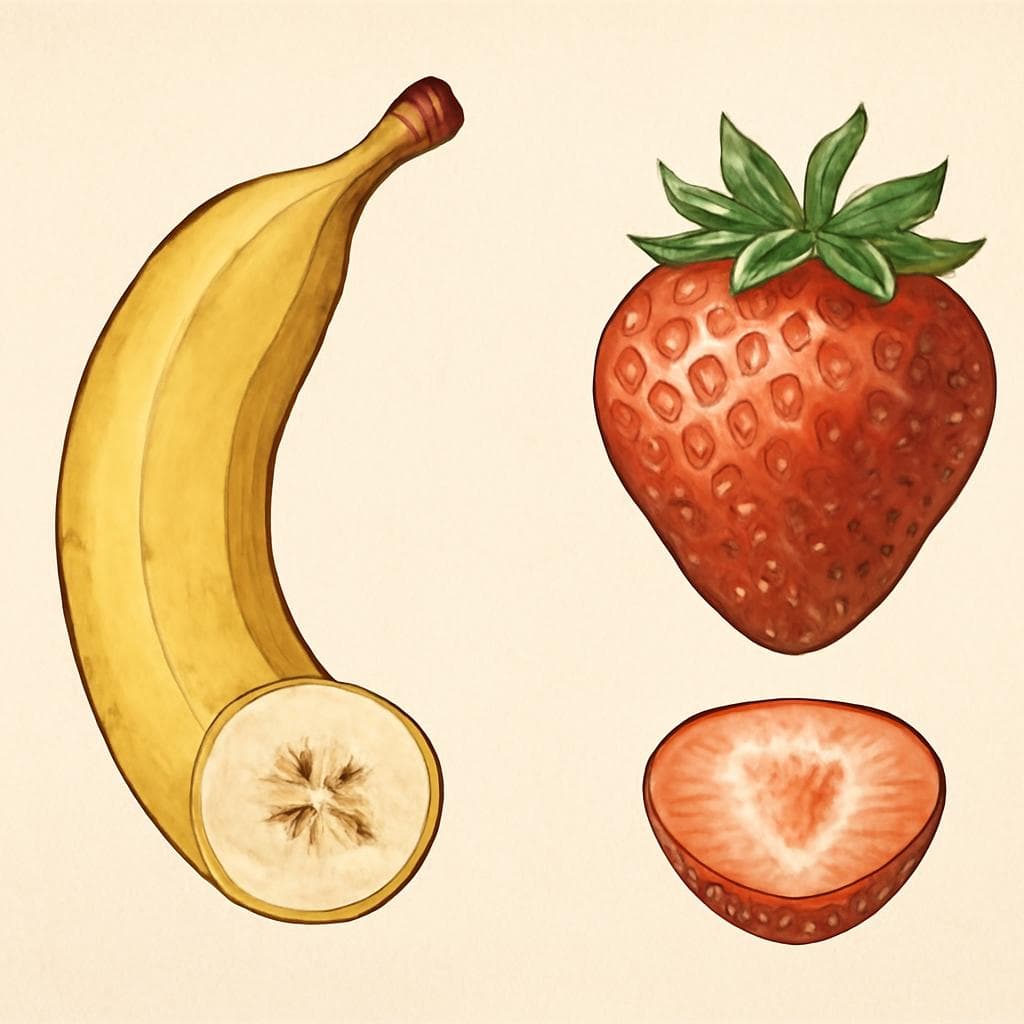
The Quiz Question
Bananas are berries, but strawberries are not
- A. True
- B. False
- C. Sometimes
- D. Unknown
The answer is A. True. Here is the full story.
It sounds like the kind of fact someone makes up to win an argument at a dinner party — but it's completely true, and the explanation comes down to how botanists actually define a berry versus how the rest of us use the word.
What Makes a Berry a Berry?
In everyday language, a berry is any small, round, juicy fruit. But in botany, the definition is far more specific. A true berry must develop from a single flower with one ovary, and it must have three distinct layers: the outer skin (exocarp), the fleshy middle (mesocarp), and an inner layer (endocarp) that surrounds the seeds. The seeds must also be embedded inside the flesh of the fruit itself.
Bananas tick every single one of those boxes. They develop from a single flower, they have those three distinct layers (that slightly waxy skin, the soft flesh, and the innermost part surrounding the seeds), and the seeds — though nearly invisible in cultivated varieties — are technically present inside. Botanically speaking, a banana is a berry. So are grapes, kiwis, avocados, and even tomatoes.
Why Strawberries Don't Qualify
Strawberries fail the botanical berry test for a very specific reason: the fleshy part you eat doesn't actually develop from the flower's ovary. Instead, it comes from the receptacle — the thickened base of the flower. The tiny yellow dots on the outside of a strawberry? Those are the actual fruits, each one technically an "achene" containing a single seed. That makes the strawberry what botanists call an "accessory fruit" or "false fruit."
So the part of a strawberry you bite into isn't even technically a fruit at all in the strict botanical sense. Mind-bending, right?
Other Surprising Berry Imposters
Strawberries aren't alone in their botanical exile. Raspberries and blackberries are also not true berries — they're "aggregate fruits," made up of many small drupelets clustered together. Cherries, peaches, and plums? Those are drupes, not berries.
Meanwhile, the list of legitimate botanical berries is genuinely surprising: watermelons, cucumbers, and pumpkins all qualify. They're technically classified as a subtype called "pepos," but they fall under the broader botanical berry umbrella.
Why the Gap Between Science and Common Language?
The mismatch comes down to history. People were naming and eating fruits long before botanical classification systems existed. Common names stuck, and the science developed its own precise vocabulary separately. Neither is "wrong" — they're just answering different questions. Ask a chef, and a strawberry is absolutely a berry. Ask a botanist, and you'll get a very different lecture.
The banana-as-berry fact is a perfect example of why scientific definitions can be so counterintuitive — and so much fun to drop into conversation when nobody's expecting it.