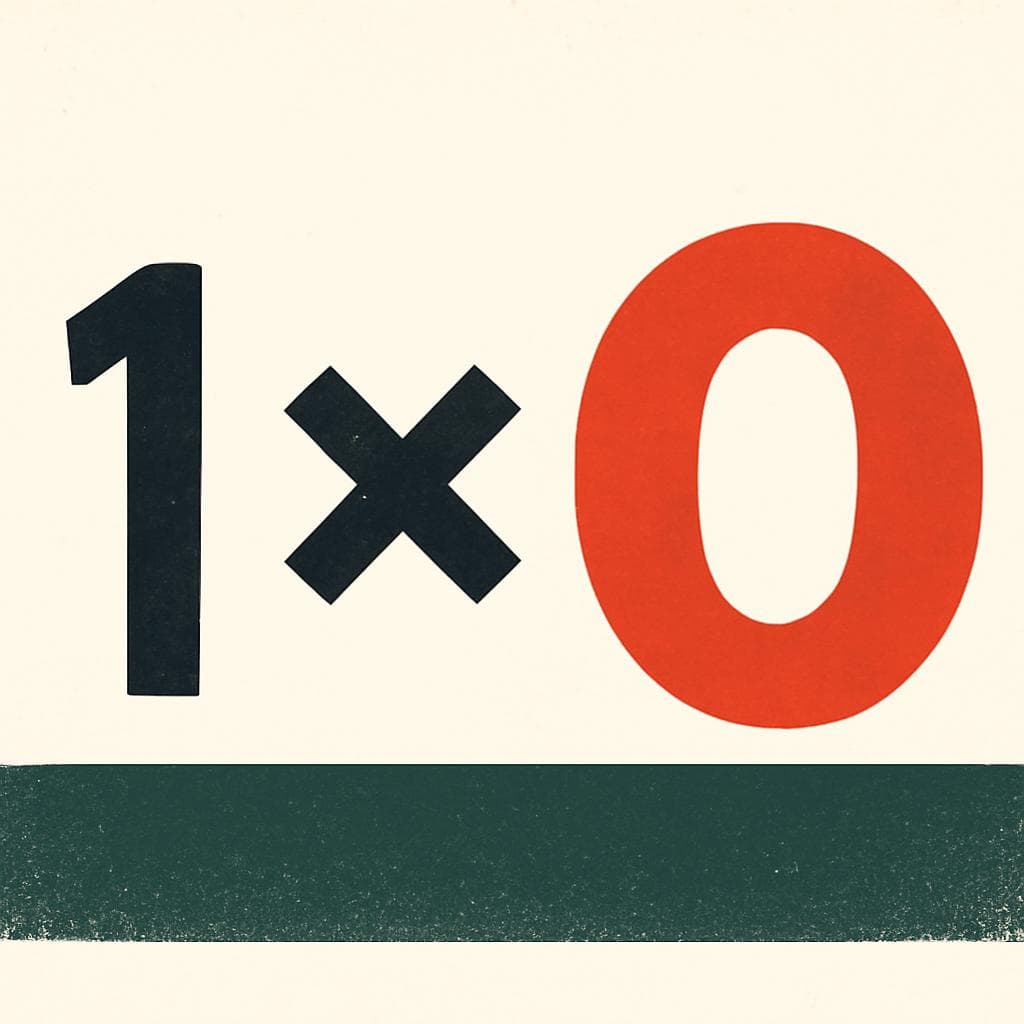
The Quiz Question
Any number multiplied by zero equals zero.
- A. True
- B. False
- C. Except infinity
- D. Only integers
The answer is A. True. Here is the full story.
Zero is one of the most fascinating numbers in mathematics, and its relationship with multiplication is one of those rules that sounds almost too simple to be true — yet it holds without a single exception.
The Zero Product Rule
Multiply any number by zero, and the result is always zero. It doesn't matter whether you're multiplying zero by a trillion, a fraction, a negative number, or even infinity in certain contexts — the answer is zero. This is formally known as the zero product property, and it's one of the foundational rules of arithmetic.
The reasoning is surprisingly intuitive. Multiplication is essentially repeated addition. If you have five groups of three apples, you have fifteen apples. But if you have zero groups of anything, you have nothing at all. Zero groups of a million is still nothing. The logic is airtight.
Why It Actually Makes Sense
Mathematicians express this more formally using the distributive property of numbers. Take any number, call it a. We know that 0 = 1 − 1. So a × 0 = a × (1 − 1) = a − a = 0. No matter what value a holds, you always end up subtracting it from itself, which always gives zero. This isn't a trick — it's a logical consequence of how numbers are structured.
This rule applies across all real numbers, negative numbers, decimals, fractions, and even irrational numbers like pi. Multiply pi by zero and you get exactly zero, not some tiny sliver of pi — just zero.
A Number That Changed History
Zero itself wasn't always considered a "real" number. Ancient civilisations like the Greeks and Romans had no symbol for zero at all. It was Indian mathematicians — most notably Brahmagupta in the 7th century CE — who first formalised zero as a number in its own right and defined how arithmetic operations, including multiplication, behaved with it.
His work laid the groundwork for the number system we use today. Without a proper understanding of zero, modern computing, physics, and engineering would simply not exist.
Where It Gets Interesting
There is one famous edge case that trips people up: zero divided by zero. That's undefined, not zero. And zero to the power of zero is a genuinely contested topic among mathematicians in certain contexts. But straight multiplication? Rock solid. Always zero.
The zero product rule also plays a crucial role in solving equations. In algebra, if you know that two things multiplied together equal zero, you immediately know that at least one of them must be zero. That single insight helps solve countless equations across science, engineering, and economics every day.
Simple on the surface, profound underneath — that's zero in a nutshell.