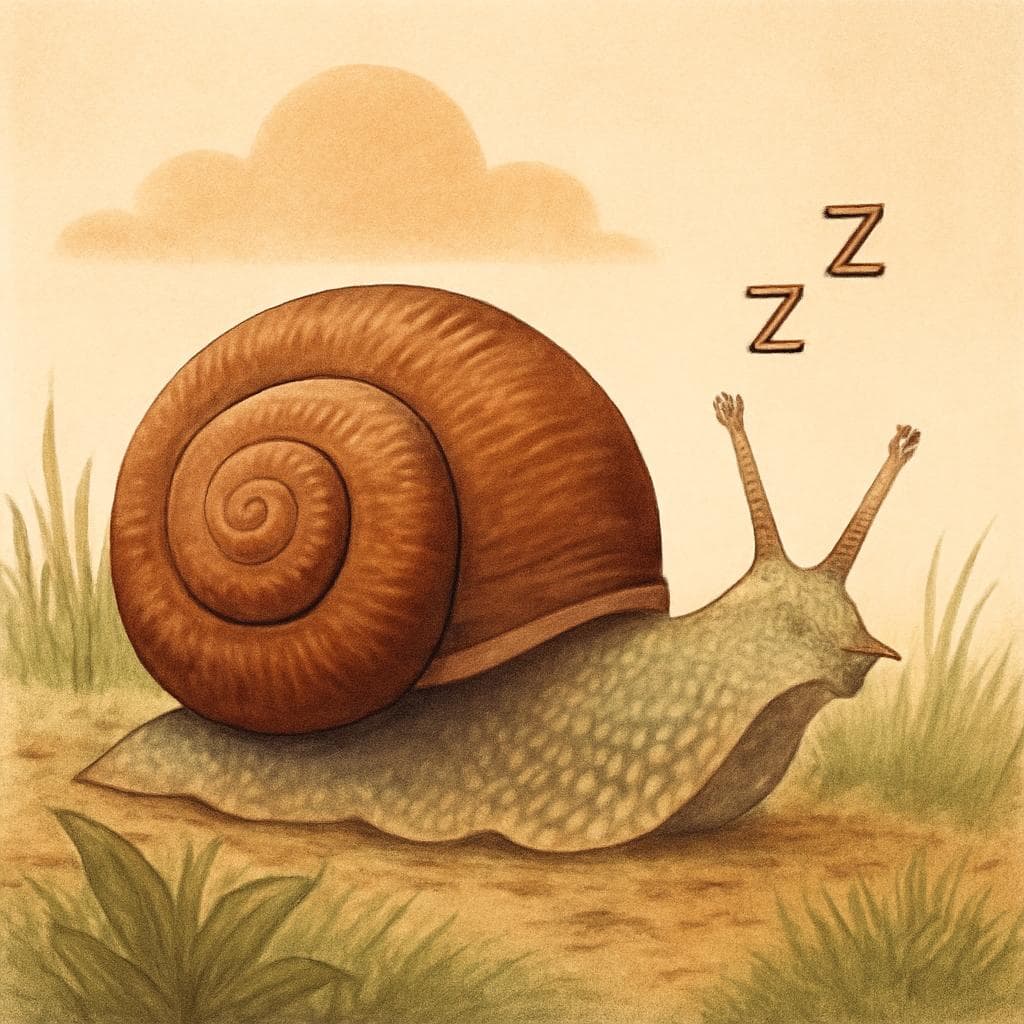
The Quiz Question
A snail can sleep for 3 years
- A. True
- B. False
- C. 1 year
- D. 5 years
The answer is A. True. Here is the full story.
Yes, it's true — and honestly, it puts your Sunday lie-in to shame. Snails are capable of entering a deep sleep-like state called estivation (or aestivation), which can last for months or, in some documented cases, up to three years. It sounds extreme, but for a creature built around survival, it makes perfect biological sense.
Why Snails Sleep So Long
Snails are incredibly sensitive to their environment. They need moisture to move, feed, and function — their entire body is essentially a muscular, slime-producing foot that dries out fast. When conditions become too dry, too hot, or too cold, a snail's best survival strategy is simply to stop doing anything at all.
During estivation, the snail retreats deep into its shell and seals the opening with a hardened layer of dried mucus called an epiphragm. This acts like a cork, locking in moisture and keeping the outside world out. The snail's metabolism slows to an absolute crawl — heart rate drops, energy consumption plummets, and the animal essentially enters a biological pause mode.
Three Years? Really?
It sounds like an exaggeration, but there's a famous real-world example to back it up. In 1846, a desert snail (Eremina desertorum) was collected in Egypt and brought to the British Museum, where it was glued to a display card as a presumed dead specimen. Four years later — in 1850 — museum staff noticed something odd. The snail was alive. It had been in estivation the entire time, sealed in its shell, waiting for conditions that never came.
That particular snail survived around four years, though the commonly cited figure for snail estivation in the wild is up to three years. The exact duration depends on the species and environmental conditions, but the biological capability is well established.
Estivation vs. Hibernation
These two states are often confused, but they're triggered by opposite problems. Hibernation is a response to cold — animals slow down to survive winter. Estivation is a response to heat and drought — animals slow down to survive dry seasons. Snails can actually do both, depending on where they live. In temperate climates, garden snails hibernate through winter. In arid regions, the same mechanism kicks in during the hottest, driest months.
What Happens When They Wake Up?
When moisture returns — whether from rain, humidity, or being placed in water — the snail breaks its epiphragm seal and slowly rehydrates. Within hours, it's moving, feeding, and behaving completely normally, as if nothing happened. No grogginess, no adjustment period. Just business as usual after potentially years of suspended animation.
It's a reminder that some of nature's most impressive survival tricks belong to the slowest creatures on the planet.