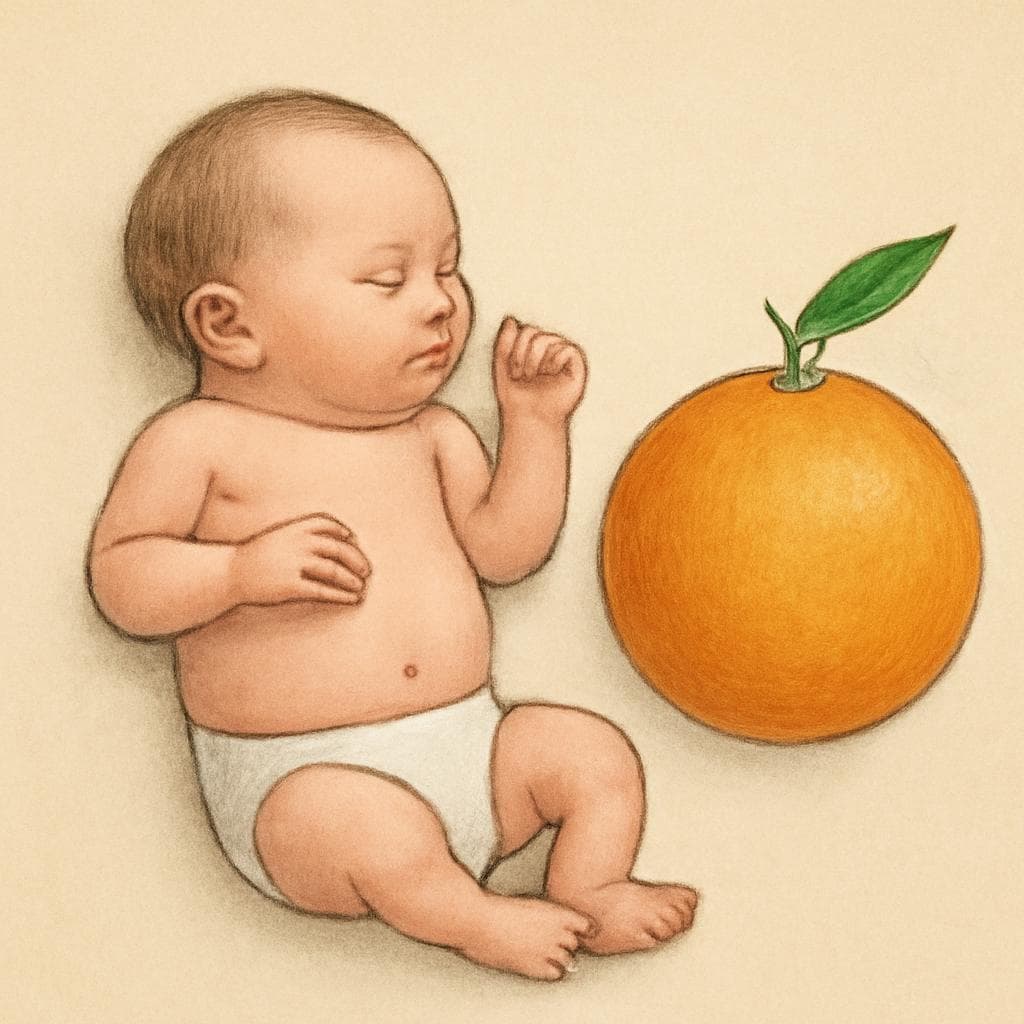
The Quiz Question
A newborn's stomach is roughly the size of what on their first day?
- A. A cherry
- B. A golf ball
- C. A tennis ball
- D. A grapefruit
The answer is A. A cherry. Here is the full story.
Tiny But Mighty: The Newborn Stomach
On the very first day of life, a baby's stomach is almost impossibly small — roughly the size of a cherry, with a capacity of just 5 to 7 millilitres. That's less than a teaspoon and a half of liquid. It's one of those facts that stops you in your tracks when you picture it.
Why So Small?
This isn't a design flaw — it's a feature. A stomach that tiny is perfectly matched to what a newborn actually receives in those first hours: colostrum, the thick, concentrated first milk produced by a nursing mother. Colostrum comes in tiny amounts, often just a few millilitres per feeding, packed with immune-boosting antibodies, proteins, and nutrients. Nature sized the stomach to match the supply exactly.
The newborn stomach is also relatively stiff and non-elastic at birth, which means it doesn't stretch much to accommodate more volume. This is why newborns feed so frequently — every one to three hours — rather than taking in larger amounts less often.
The Growth Curve Is Rapid
What's remarkable is how quickly things change. By day three, the stomach expands to roughly the size of a walnut, holding around 22 to 27 millilitres. By the end of the first week, it's grown to the size of an apricot, with a capacity closer to 45 to 60 millilitres. And by the time a baby is one month old, it can hold around 80 to 150 millilitres — nearly the size of a large chicken egg.
This rapid expansion mirrors the equally rapid increase in a mother's milk supply, which transitions from colostrum to mature milk around days three to five postpartum. The timing is no coincidence.
What This Means for Feeding
Understanding the cherry-sized stomach helps explain a lot of new-parent experiences that can feel alarming. Frequent feeding, small spit-ups, and a baby who seems hungry again almost immediately after eating are all completely normal responses to having a stomach measured in single-digit millilitres.
It also explains why overfeeding a newborn can lead to discomfort. If more milk goes in than the stomach can comfortably hold, the excess has nowhere to go but back up. Those postfeed spit-ups are often just physics at work.
A Reminder of How Tuned-In Biology Really Is
The cherry-sized stomach is one of the more elegant examples of how precisely calibrated newborn biology is. Everything — stomach size, feeding reflex, colostrum volume, milk transition timing — fits together like a system that has been refined over hundreds of thousands of years of human development.
So the next time you see a cherry sitting in a bowl, you'll have a whole new appreciation for just how much work something that small can do.