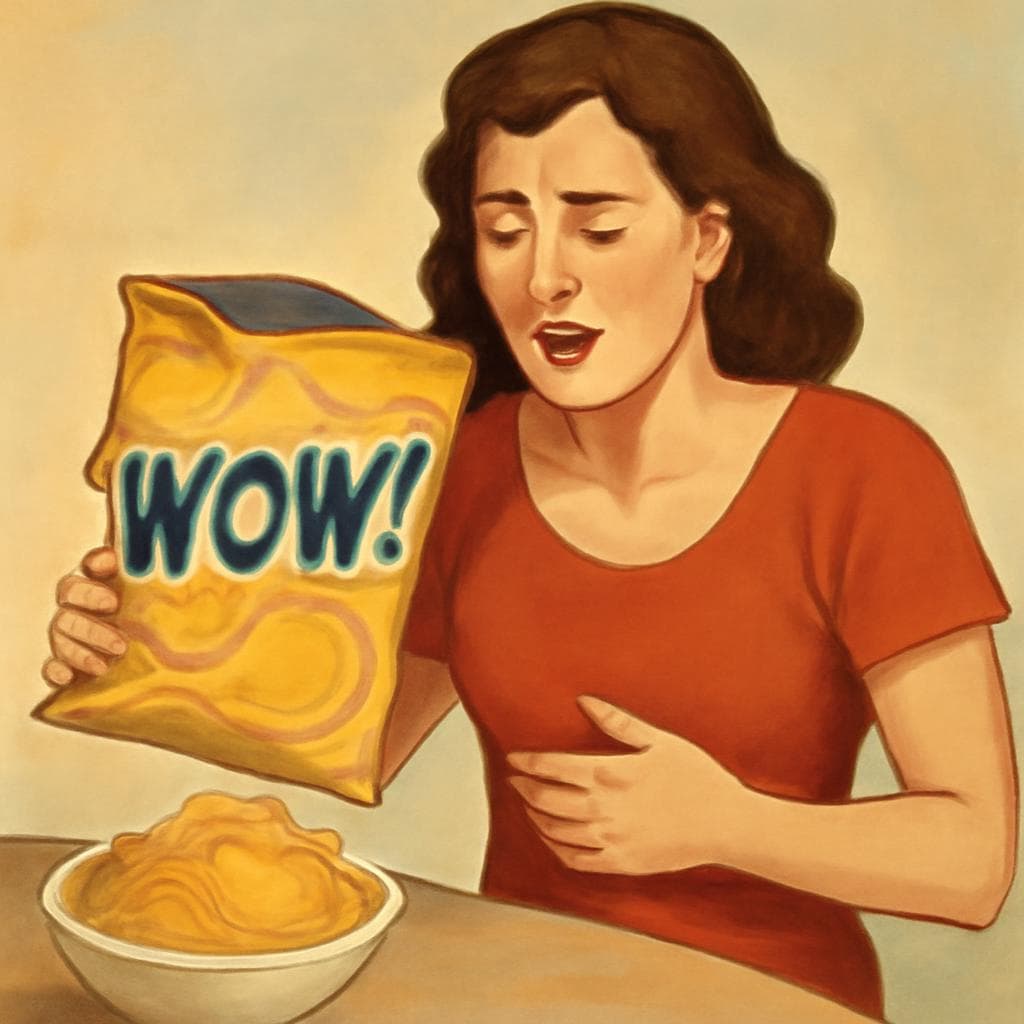
The Quiz Question
Why did Frito-Lay's WOW! chips with Olestra flop in the late 1990s?
- A. They were too salty
- B. The Olestra fat substitute caused digestive issues and warning labels
- C. They cost too much
- D. They were never advertised
The answer is B. The Olestra fat substitute caused digestive issues and warning labels. Here is the full story.
The Fat-Free Dream That Went Wrong
In the mid-1990s, Frito-Lay thought it had cracked one of snacking's biggest puzzles: how do you make a chip that tastes like the real thing but carries none of the fat? The answer, they believed, was Olestra — a synthetic fat substitute developed by Procter & Gamble after more than two decades of research. The FDA approved it in January 1996, and the hype was enormous. Time magazine named Olestra one of the best inventions of the year.
Frito-Lay launched its WOW! line of chips — including Lay's, Ruffles, and Doritos varieties — in 1998. Sales exploded out of the gate, pulling in around $400 million in the first year. America was deep in its fat-phobia era, and the promise of a guilt-free chip felt like a miracle. For a hot minute, WOW! looked like one of the most successful snack launches in history.
The Stomach-Churning Catch
Then came the label. The FDA required every WOW! product to carry a warning that read: "This Product Contains Olestra. Olestra may cause abdominal cramping and loose stools. Olestra inhibits the absorption of some vitamins and other nutrients." That warning wasn't subtle, and it wasn't easy to ignore when it was printed right on the bag you were about to tear open.
Olestra's problem was biological. Because it's a molecule too large for the body to absorb, it passes straight through the digestive system — and it doesn't always do so quietly. Reports of cramping, diarrhea, and a particularly unpleasant phenomenon that consumers euphemistically called "anal leakage" spread fast. The Center for Science in the Public Interest logged thousands of complaints and campaigned aggressively against the ingredient. Late-night comedians had a field day, and the brand became punchline material almost overnight.
The Perception Problem
Even for consumers who never personally experienced any side effects, the warning label did irreparable damage. Food psychology is powerful — once your brain associates a snack with potential gastrointestinal chaos, no amount of crunch can fully override that association. Shoppers who might have been perfectly fine eating a handful of WOW! chips started leaving the bags on the shelf, unwilling to take the risk.
Sales collapsed through 1999 and into the early 2000s. Frito-Lay quietly rebranded the line as "Light" chips, dialing back the WOW! branding, and the FDA eventually dropped the mandatory warning in 2003 after concluding the side effects had been overstated. But the damage was done.
A Cautionary Tale in Snack History
WOW! chips remain one of the most studied examples of how a single piece of on-package text can sink a product. The science behind Olestra was real, the taste testing was solid, and the market demand was genuine — but no marketing budget in the world could outrun a warning label that made consumers picture the worst. Sometimes in the food industry, the fine print is everything.