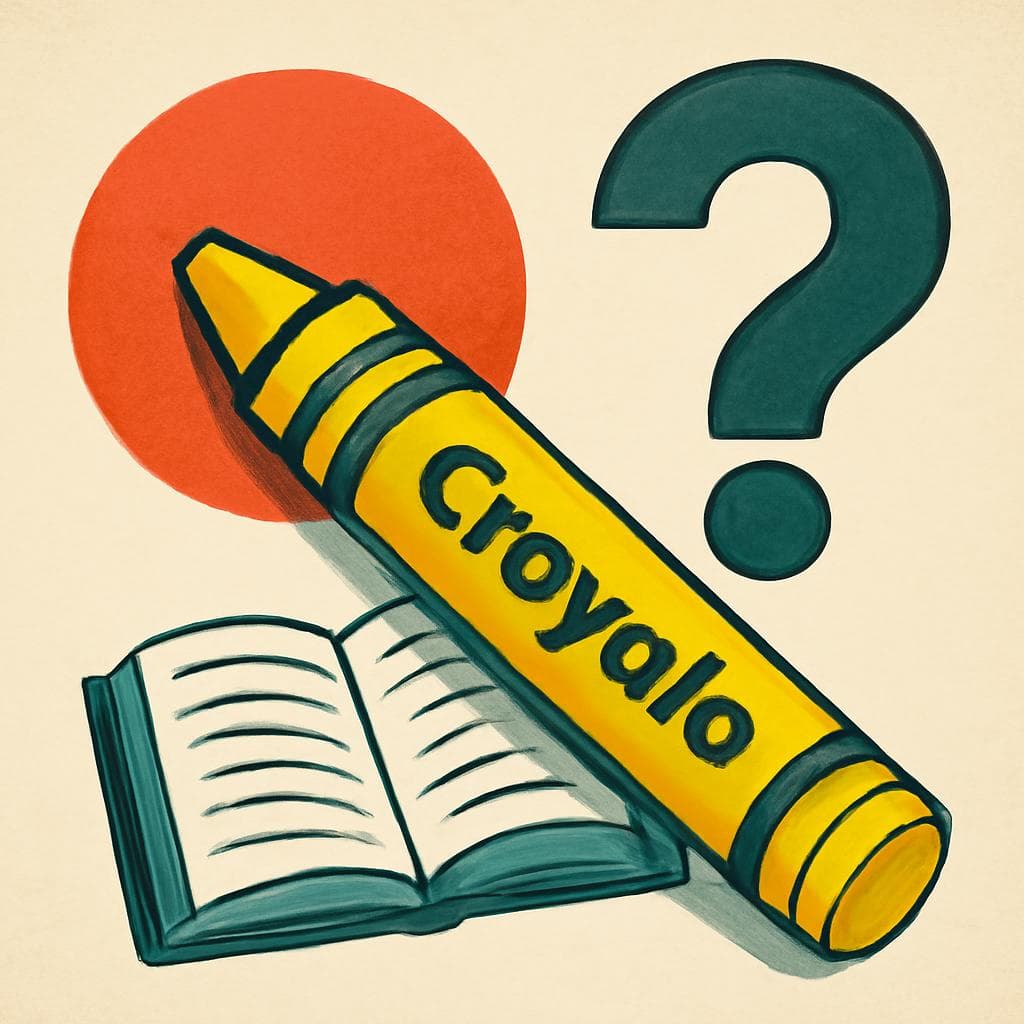
The Quiz Question
Where does the name 'Crayola,' as in the crayons, actually come from?
- A. It's the founder's surname
- B. French words for 'chalk' and 'oily'
- C. A Native American word
- D. It's an acronym for the founding company
The answer is B. French words for 'chalk' and 'oily'. Here is the full story.
The Surprisingly French Origins of a Childhood Staple
You probably spent a good chunk of your childhood with a Crayola crayon in your hand, but did you ever stop to wonder what the name actually means? Turns out, it's a clever little blend of two words — one French, one rooted in science — that perfectly describes exactly what a crayon is made of.
Breaking Down the Name
The "Cray" part comes from craie, the French word for chalk. That makes sense — crayons have a chalky, waxy texture and were originally seen as a step up from chalk sticks used in classrooms. The second half, "ola," is a shortened form of oleaginous, an English word derived from Latin meaning oily or greasy. Put them together and you've essentially got "oily chalk" — which is honestly a pretty accurate description of what a crayon is.
The name was coined by Alice Stead Binney, wife of Crayola co-founder Edwin Binney. Edwin and his business partner C. Harold Smith had already built a successful industrial pigment company — Binney & Smith — before turning their attention to the classroom. Alice, a former school teacher herself, came up with the name around 1903, and it was trademarked that same year.
From Industrial Pigments to the Iconic Yellow Box
The leap from industrial paint to children's crayons wasn't as random as it sounds. Binney & Smith had already started making dustless chalk for schools, winning a gold medal at the 1900 Paris Exposition for it. From there, creating an affordable, safe, wax-based crayon for kids was a natural next step. The first box of Crayola crayons sold for a nickel and contained eight colors: red, orange, yellow, green, blue, violet, brown, and black — the same core colors most of us started with.
The wax used in those original crayons — and still today — is paraffin wax, which is what gives them that slightly oily, smooth glide. Combined with pigment, it creates that distinctive smell that's so nostalgic it was actually named one of the most recognizable scents in America by Yale University researchers.
A Name Built to Last
What makes the Crayola name so brilliant in hindsight is that it's both descriptive and completely original. It sounds playful, rolls off the tongue easily, and gives no real hint that it's rooted in French vocabulary — which is probably part of why it never felt stuffy or technical to generations of kids.
More than 120 years after that first five-cent box, Crayola now produces over 3 billion crayons a year, in more than 120 colors. But the name still quietly carries that same simple, honest meaning: oily chalk. Not bad for a word invented by a schoolteacher's wife in 1903.