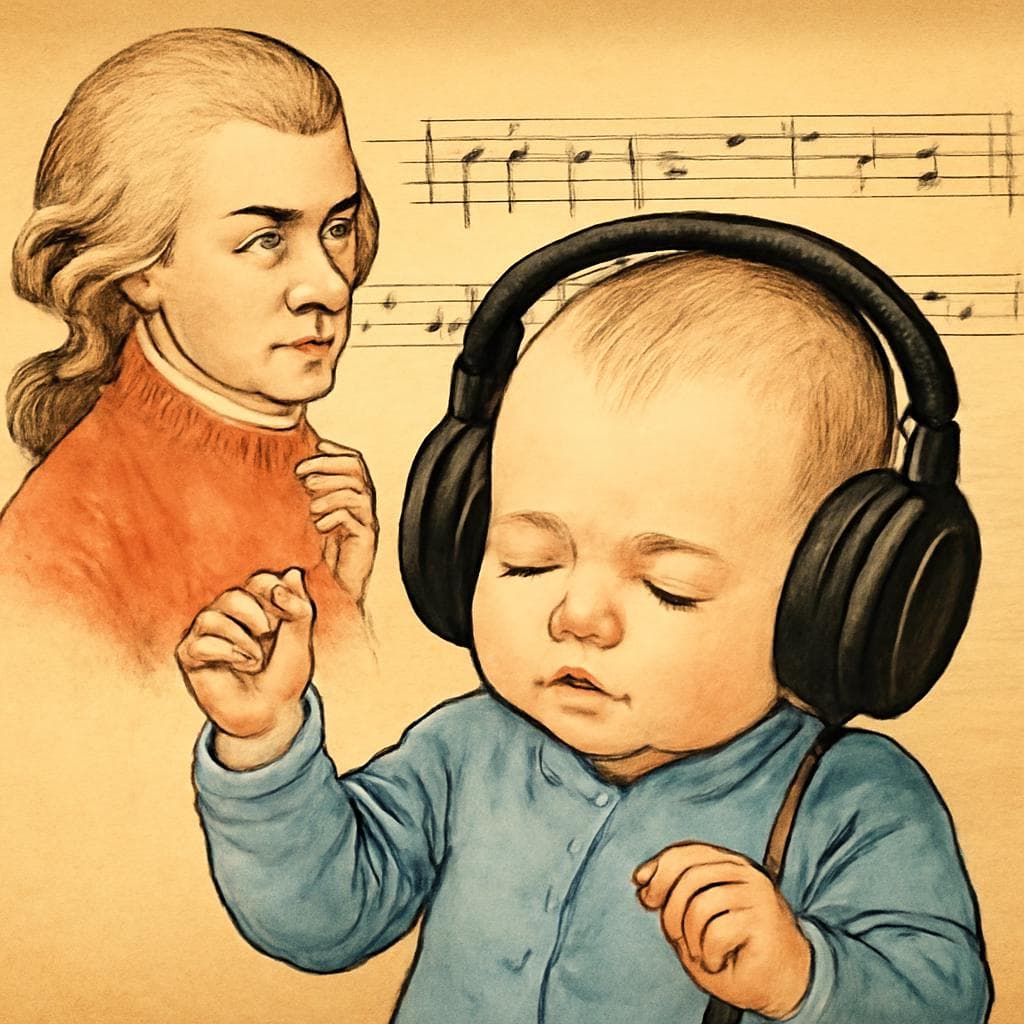
The Quiz Question
The famous 'Mozart Effect,' claiming classical music makes babies smarter, actually came from a study on...
- A. College students, not babies at all
- B. A group of infant twins
- C. Kindergarten teachers
- D. Newborn laboratory mice
The answer is A. College students, not babies at all. Here is the full story.
The Mozart Effect: One of Pop Science's Biggest Myths
If you've ever seen a pregnant person holding headphones to their belly, or spotted a "Baby Einstein" DVD at a garage sale, you've witnessed the cultural fallout from one of the most spectacularly misunderstood studies in modern science.
The whole thing traces back to a paper published in Nature in 1993 by researchers Rauscher, Shaw, and Ky. The study was small — just 36 college students — and the setup was straightforward. Participants listened to ten minutes of Mozart's Sonata for Two Pianos in D Major (K. 448), sat in silence, or listened to relaxation instructions. Then they took a spatial reasoning test: the kind where you mentally fold paper and predict what shape it makes.
The Mozart group scored higher. Not dramatically, not permanently — but measurably, in that one task, for roughly 10 to 15 minutes afterward. That's it. That's the whole study.
How a College Experiment Became Baby Advice
The leap from "college students did slightly better on a spatial test for fifteen minutes" to "play Mozart to your newborn to make them smarter" is genuinely staggering. But it happened fast. Media coverage stripped away the caveats, the narrow scope, and the brief duration. By the mid-1990s, the "Mozart Effect" had taken on a life of its own.
In 1998, Georgia Governor Zell Miller proposed a state budget that included funding to send classical music CDs to every newborn in the state. Florida passed legislation requiring classical music to be played in state-funded childcare centers. A whole industry — Baby Einstein, Baby Mozart, BabyGenius — built itself on the premise.
The researchers themselves never claimed their findings applied to babies. Frances Rauscher, one of the original authors, spent years trying to walk back the public interpretation, clarifying that the study said nothing about infant development or long-term intelligence gains.
What the Follow-Up Research Found
Subsequent attempts to replicate even the original modest effect in adults produced mixed results. A major 1999 analysis found no reliable Mozart Effect at all. A comprehensive German review in 2010 concluded that any short-term boost was likely just due to mood and arousal — upbeat music makes you more alert and engaged, whether it's Mozart, Blur, or a podcast you enjoy.
As for babies? Studies have consistently failed to show that classical music exposure during infancy produces lasting cognitive benefits. What does help infant brain development is considerably less glamorous: responsive caregiving, talking and reading to children, sleep, and play.
Why the Myth Stuck
The Mozart Effect spread because it was irresistible — a simple, elegant hack for anxious parents who wanted to give their kids an edge. It felt scientific, it felt harmless, and it felt productive. That combination is almost impossible to debunk, even with decades of contrary evidence.
The real lesson isn't about Mozart. It's about how quickly a single small study can morph into received wisdom when the cultural conditions are just right.