The Quiz Question
Which artist painted the ceiling of the Sistine Chapel?
- A. Leonardo da Vinci
- B. Raphael
- C. Michelangelo
- D. Donatello
The answer is C. Michelangelo. Here is the full story.
The Man Behind One of History's Greatest Masterpieces
When Pope Julius II summoned Michelangelo to Rome in 1508, the artist was reluctant. He considered himself a sculptor first and foremost — the man who had already given the world the breathtaking David — and he wasn't convinced he was the right person for a painting job. He even wrote to a friend that painting "is not my profession." History, fortunately, ignored his protests.
Four Years on His Back
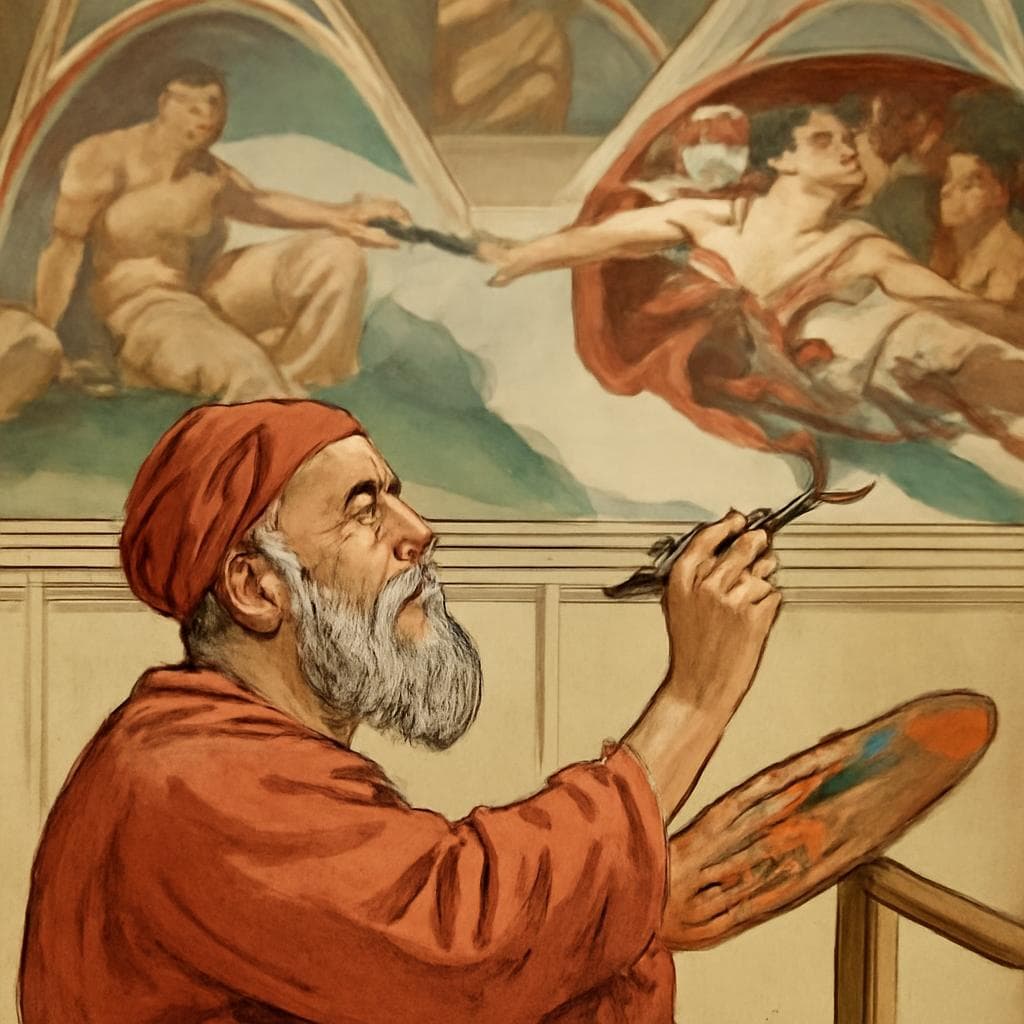
The project took four grueling years, from 1508 to 1512. Contrary to the popular image, Michelangelo didn't lie on his back to paint — he stood on custom-built scaffolding, craning his neck upward for hours on end. He later wrote a satirical poem describing his misery: his beard pointing skyward, paint dripping into his eyes, his spine bent like a bow. The physical toll was immense.
The ceiling stretches roughly 40 meters long and 13 meters wide — about the size of a basketball court above your head. Michelangelo covered it with over 300 individual figures, working largely alone after dismissing his assistants early in the project, unsatisfied with their work.
What's Actually Up There
Most people picture the famous Creation of Adam — that iconic image of God reaching out to touch Adam's finger — and stop there. But the ceiling tells a sweeping narrative drawn from the Book of Genesis, divided into nine central panels. The story moves from the separation of light and darkness, through the creation of the earth and mankind, all the way to the drunkenness of Noah.
Surrounding those panels are painted figures of prophets and sibyls — ancient seers from both the Hebrew and classical traditions — along with dozens of other figures filling every available corner. The sheer ambition of the composition is staggering even today.
A Complicated Relationship with the Pope
Michelangelo and Julius II had a famously tense working relationship. Julius was demanding, impatient, and kept pressuring the artist to finish sooner. At one point, Julius reportedly struck Michelangelo with his staff during an argument. The artist briefly fled Rome in protest. Yet somehow, this fractious partnership produced one of the most celebrated works of art ever created.
The Legacy
When the ceiling was unveiled on November 1, 1512 — All Saints' Day — it immediately stunned Rome. Fellow Renaissance giant Raphael is said to have altered his own painting style after seeing it, so profound was its influence. Michelangelo went on to add The Last Judgment to the altar wall decades later, between 1536 and 1541, cementing the Sistine Chapel as his life's defining monument.
Not bad for someone who insisted he wasn't a painter.