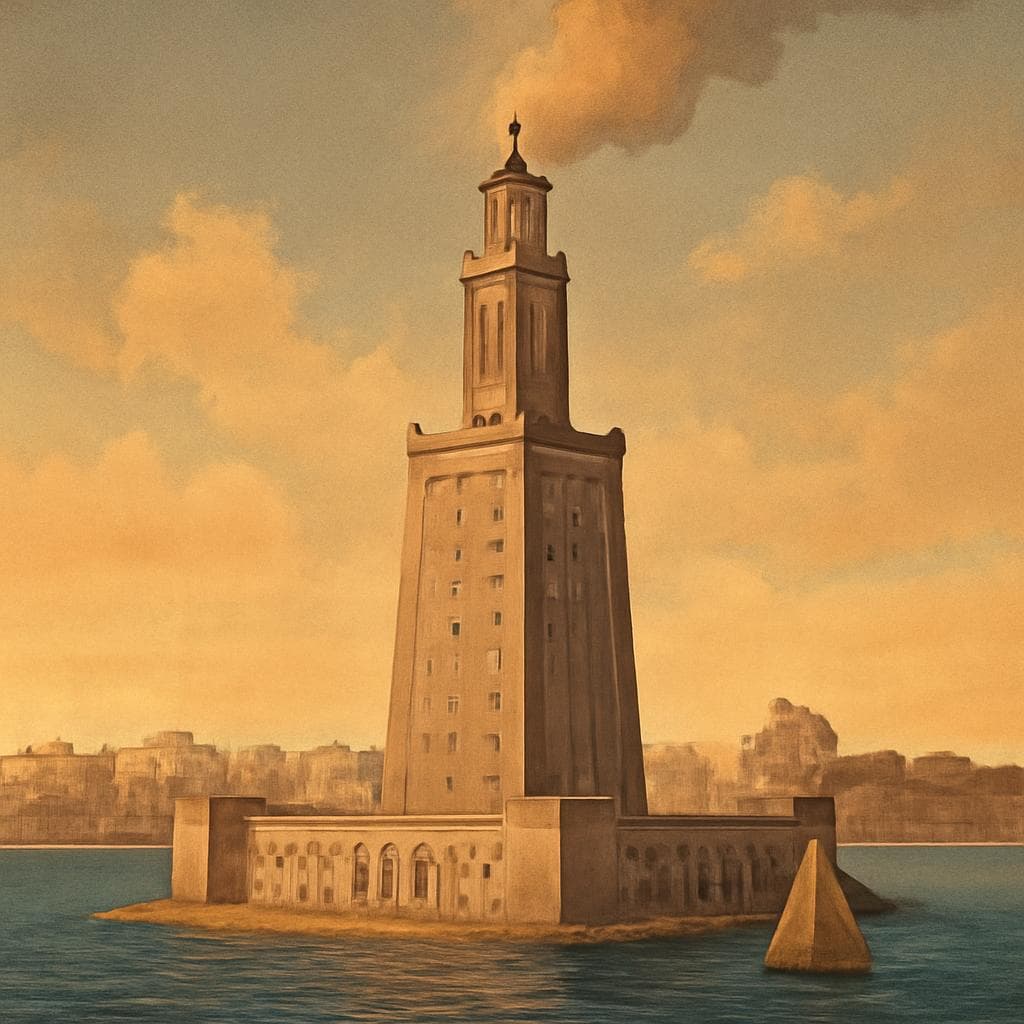
The Quiz Question
Which ancient wonder of the world was located in Alexandria, Egypt?
- A. The Colossus of Rhodes
- B. The Great Lighthouse
- C. The Hanging Gardens
- D. The Temple of Artemis
The answer is B. The Great Lighthouse. Here is the full story.
The Ancient Wonder That Lit the Way
Rising somewhere between 100 and 140 metres into the Mediterranean sky, the Lighthouse of Alexandria — known in antiquity as the Pharos — was one of the tallest structures human hands had ever built. For sailors navigating the treacherous coastline of northern Egypt, it wasn't just impressive architecture. It was the difference between life and death.
Built on an Island, Built to Last
Construction began around 280 BC, during the reign of Ptolemy II Philadelphus, on a small island called Pharos just off the coast of Alexandria. The city itself had been founded by Alexander the Great in 331 BC, and his successors were determined to make it the intellectual and commercial capital of the known world. A reliable beacon for incoming trade ships was essential to that ambition.
The architect is believed to have been Sostratus of Cnidus, a Greek designer who — according to ancient accounts — was so proud of his work that he secretly carved his own name into the foundation stonework, hiding it beneath a layer of plaster that bore the king's name instead. He knew the plaster would eventually crumble. His inscription, he figured, would outlast royal vanity.
How It Actually Worked
The lighthouse was built in three distinct tiers: a square base, an octagonal middle section, and a cylindrical top. At its peak sat a large mirror — likely polished bronze — that reflected sunlight during the day and firelight at night. Ancient sources claim the beam could be seen from distances of up to 50 kilometres out at sea, though historians treat those figures with some caution.
What's not in doubt is that it worked remarkably well for centuries. The word "pharos" itself became so synonymous with lighthouses that it filtered into multiple languages — the French word phare, the Italian faro, and the Spanish faro all trace their roots directly back to this single building.
A Slow Disappearance
The Pharos wasn't destroyed in a single dramatic moment. A series of earthquakes — particularly severe ones in 956 AD, 1303 AD, and 1323 AD — gradually reduced it to rubble over the centuries. By the time the Arab traveller Ibn Battuta visited Alexandria in the 14th century, he described a structure so ruined it was impossible to even enter.
In 1480, the Sultan of Egypt used the remaining stones to build a medieval fort on the same site — the Citadel of Qaitbay, which still stands today. Archaeologists exploring the harbour floor nearby have recovered enormous granite blocks that almost certainly once formed part of the lighthouse itself.
A Wonder Worth Remembering
Of the original Seven Wonders of the Ancient World, only the Great Pyramid of Giza still stands. The Pharos of Alexandria is gone, but its legacy is built into the very language we use for navigational lights around the world. Not a bad monument for a structure that simply existed to help sailors find the shore.