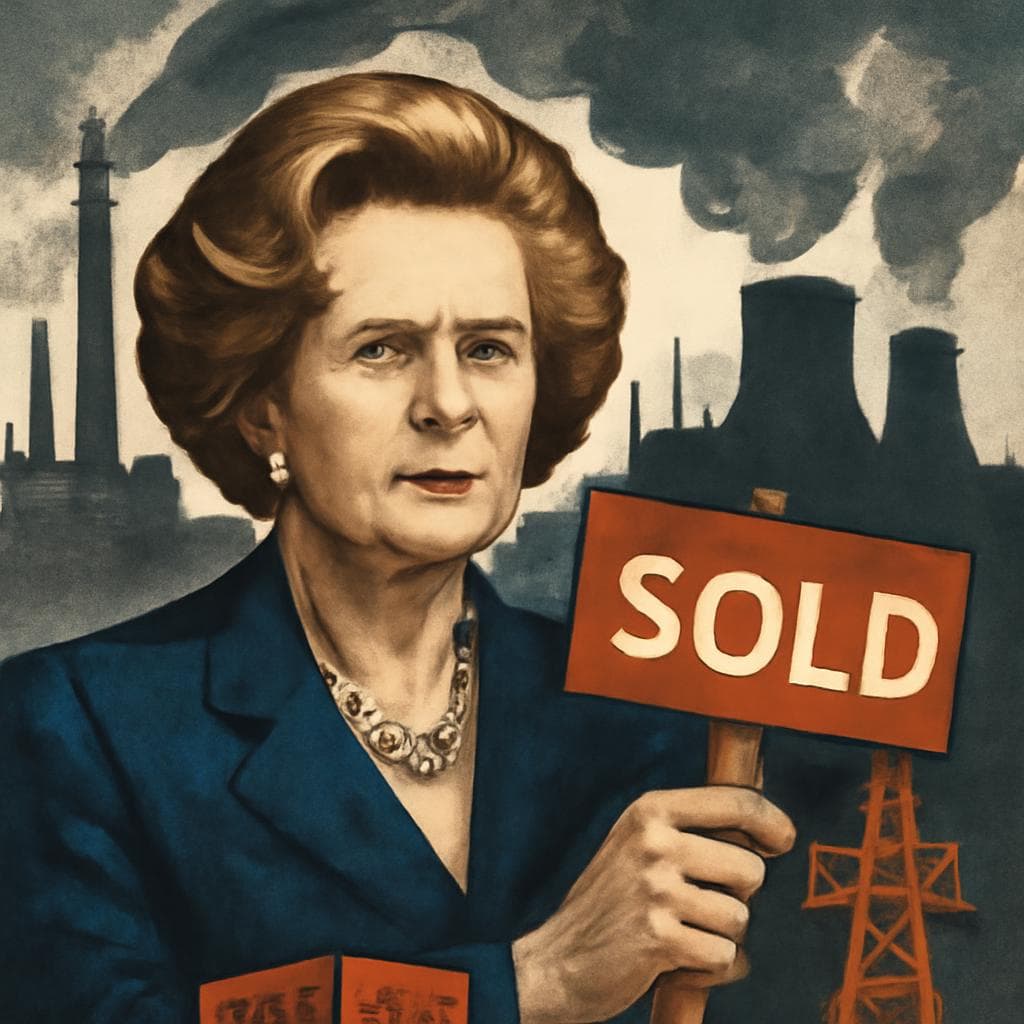
The Quiz Question
Thatcher privatised major industries in the 1980s. What was her core aim?
The answer is To reduce the role of the state and increase economic efficiency through free market competition, while reducing public spending and government borrowing (broadly: promoting free-market capitalism / reducing state intervention in the economy).. Here is the full story.
Selling Off the Silver: Why Thatcher Put Britain's Industries Up for Sale
When Margaret Thatcher swept to power in 1979, Britain was a country where the government owned the phone network, the gas supply, the national airline, the water system, and the steel mills. To Thatcher, this wasn't public service — it was a slow-motion catastrophe.
Her diagnosis was straightforward: state-owned industries had no real incentive to perform. Sheltered from competition and propped up by taxpayer money, they had grown bloated, inefficient, and resistant to change. British Leyland, the nationalised car manufacturer, had become a byword for poor quality and crippling strikes. The National Coal Board was running loss-making pits that the state quietly subsidised year after year. Thatcher believed the market was a far more brutal and effective judge of performance than any government minister could ever be.
The Free Market as a Political Philosophy
Her thinking drew heavily on economists like Friedrich Hayek and Milton Friedman, who argued that central planning distorted prices, killed innovation, and ultimately made everyone poorer. The state, in their view, should step back and let competition do the work. Thatcher took this seriously — not just as economics, but as a moral position. She believed dependence on the state undermined individual responsibility and initiative.
Privatisation was the practical expression of that belief. Between 1979 and 1990, her government sold off British Telecom, British Gas, British Airways, British Steel, the water authorities, the electricity industry, and British Petroleum, among others. The sales raised over £50 billion for the Treasury — money that reduced public borrowing and helped fund tax cuts.
Wider Share Ownership and the "People's Capitalism"
There was also a deliberate political dimension. By selling shares to the general public at attractive prices, Thatcher wanted to create a new class of small shareholders — ordinary workers who had a personal stake in the success of private enterprise. The "Tell Sid" advertising campaign for British Gas in 1986 became one of the most memorable marketing pushes of the decade. Share ownership in the UK roughly doubled during the 1980s as a result.
Critics argued the process sold national assets too cheaply, benefited wealthy investors more than ordinary people, and simply replaced public monopolies with private ones — British Telecom and British Gas weren't suddenly competing with anyone. Trade unions, Labour politicians, and many economists warned that profit motives would lead to underinvestment and higher prices for essential services, particularly in water and energy.
A Legacy That Still Divides
Decades on, the debate hasn't settled. Privatised industries like telecoms and airlines became genuinely competitive and more innovative. Others, particularly the railways and water companies, have attracted persistent criticism over standards, investment, and executive pay. Some have even been partially renationalised.
Whatever your verdict, Thatcher's privatisation programme fundamentally redrew the boundary between state and market in Britain — and that, from her perspective, was precisely the point.