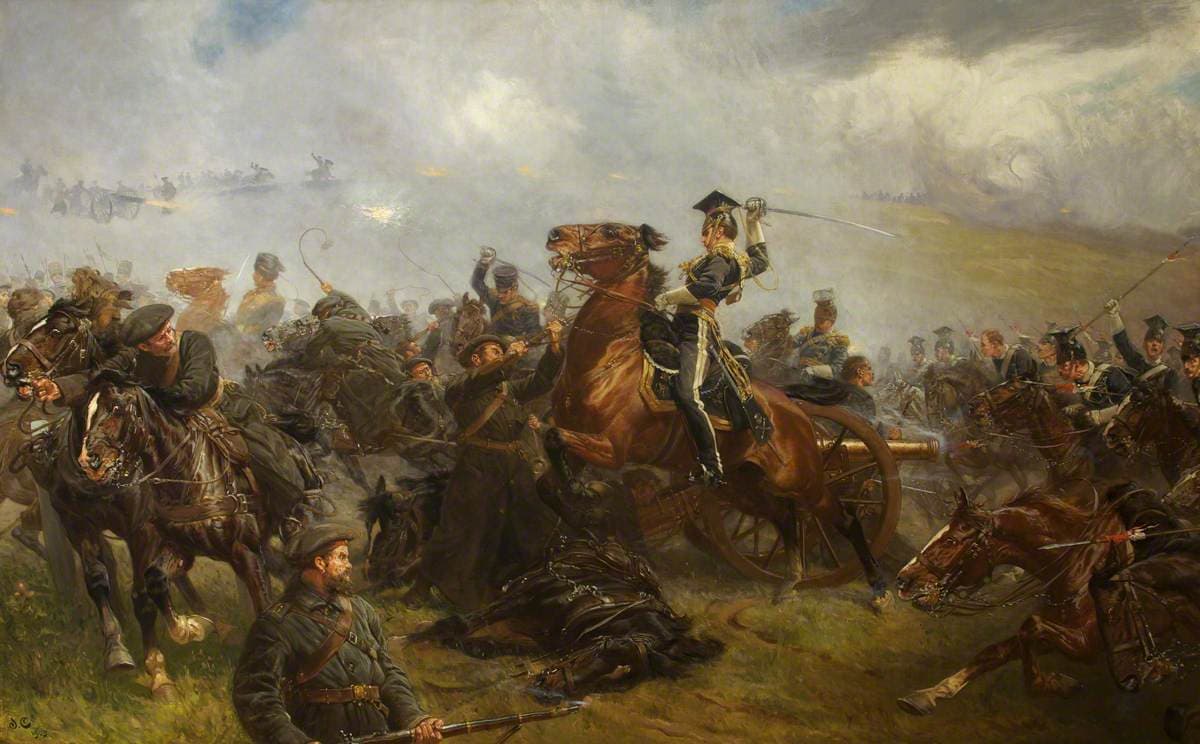
The Quiz Question
During the Crimean War in 1854, a mistaken order led to which doomed cavalry charge at the Battle of Balaclava?
- A. The Charge of the Light Brigade
- B. The Charge of the Heavy Brigade
- C. The Thin Red Line
- D. The Siege of Sevastopol
The answer is A. The Charge of the Light Brigade. Here is the full story.
The Charge That Should Never Have Happened
On the morning of 25 October 1854, one of the most catastrophic — and strangely celebrated — blunders in military history unfolded on a narrow valley near Balaclava in Crimea. Around 670 British cavalrymen rode straight into the mouths of massed Russian artillery, and the world never forgot it.
A Perfect Storm of Miscommunication
The disaster began with a simple message that went catastrophically wrong. The British commander Lord Raglan, watching from high ground, could see Russian forces attempting to drag away captured British guns from a ridge. He sent a written order via his aide, Captain Louis Nolan, instructing the cavalry to advance rapidly and prevent the guns from being taken.
The problem? The cavalry commander on the ground, Lord Lucan, couldn't see those guns from his position in the valley. When he asked Nolan which guns Raglan meant, Nolan — either through frustration, arrogance, or genuine confusion — reportedly gestured vaguely toward the far end of the valley. That end was defended by a full battery of Russian artillery, with more guns on the surrounding slopes.
Lucan passed the order to the Light Brigade's commander, Lord Cardigan, who reportedly knew it was madness but followed orders. The brigade formed up and rode forward.
Into the Valley of Death
The charge covered roughly a mile and a quarter under withering fire from three sides. Horses and men fell in waves. Captain Nolan, riding at the front, was one of the first killed — struck by a shell fragment before the brigade even reached the guns. Eyewitnesses later debated whether he was trying to redirect or halt the charge in those final seconds.
Remarkably, the Light Brigade actually reached the Russian guns and briefly overran the battery. But with no infantry support and no way to hold the position, the survivors had to ride back through the same lethal corridor of fire. Of the roughly 670 men who charged, around 110 were killed and nearly 160 wounded. Hundreds of horses were lost.
A French general watching from the sidelines reportedly said, "C'est magnifique, mais ce n'est pas la guerre" — "It is magnificent, but it is not war."
The Poem That Made It Immortal
Alfred, Lord Tennyson read a newspaper account of the charge just days after it happened and wrote his famous poem within minutes, according to his own account. The Charge of the Light Brigade, published in December 1854, cemented the event in cultural memory. Lines like "Theirs not to reason why, / Theirs but to do and die" became shorthand for blind obedience to authority — both a tribute and a quiet indictment.
The charge achieved nothing strategically. But it became one of history's most enduring examples of how a single confused order, passed down a chain of command without question, can send brave men riding toward certain death.