The Quiz Question
Which country has the longest coastline in the world?
- A. Russia
- B. Australia
- C. Canada
- D. Indonesia
The answer is C. Canada. Here is the full story.
Canada's Coastline: A Staggering Geographic Record
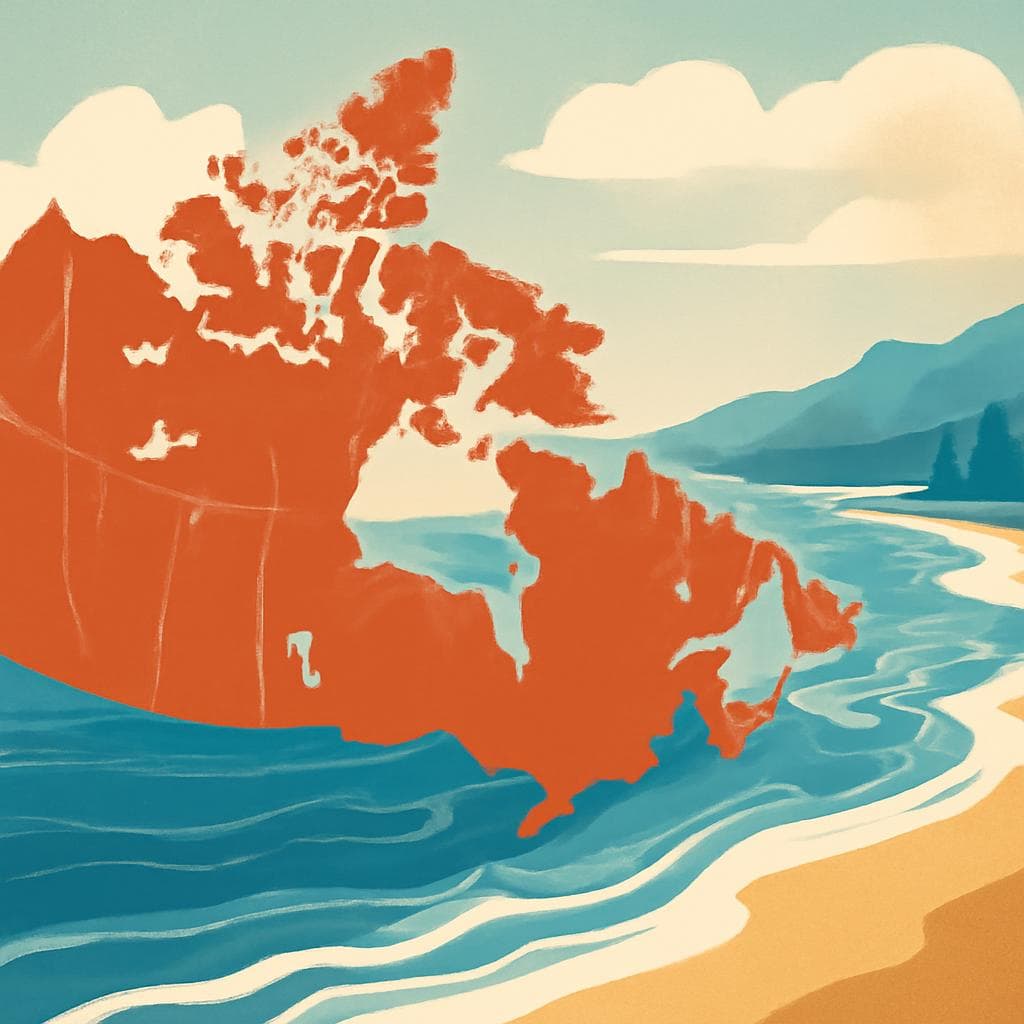
Stretching an almost incomprehensible 202,080 kilometres, Canada's coastline is the longest of any country on Earth. To put that into perspective, it wraps around the planet roughly five times over. No other nation even comes close — Indonesia, ranked second, clocks in at around 54,716 km, and Russia sits third at approximately 37,653 km. Canada's lead isn't slim; it's a total domination of the category.
Why Is It So Long?
The sheer length comes down to Canada's extraordinary geography. The country borders three oceans — the Pacific to the west, the Atlantic to the east, and the Arctic to the north. But the real secret weapon is Canada's Arctic Archipelago, a massive cluster of over 36,000 islands scattered across the far north. Every island adds more shoreline to the tally, and many of those islands are themselves deeply indented with bays, inlets, and fjords.
Canada also has an enormous number of inland coastal features counted in official measurements, including tidal rivers, bays, and the shores of coastal islands large and small. The more jagged and complex a coastline, the longer it measures — and Canada's northern coast is about as jagged as geography gets.
The Coastline Paradox
There's a fascinating mathematical wrinkle here worth knowing about: coastline measurements are never truly fixed. The finer the scale you use to measure, the longer the coastline becomes, because you capture more and more tiny curves, inlets, and bumps. This is known as the coastline paradox, a concept linked to fractal geometry. Canada's figure of 202,080 km is based on a specific measurement methodology — different approaches yield different numbers, with some estimates running even higher.
Three Oceans, Ten Provinces, Three Territories
Canada's coastal provinces and territories stretch from British Columbia in the west, with its dramatic Pacific fjords and forested islands, all the way through Atlantic provinces like Nova Scotia and Newfoundland and Labrador, whose rocky shores have shaped centuries of fishing culture. Head north into Nunavut and the Northwest Territories, and you enter an Arctic coastal wilderness of sea ice, permafrost, and polar bears — remote, raw, and largely untouched.
A Coastline With Real-World Consequences
This isn't just a trivia bragging right. Managing such an enormous coastline is a genuine logistical and political challenge for Canada. Coast guard operations, Indigenous land and sea rights, shipping routes, environmental protection, and Arctic sovereignty all hinge on those 202,080 kilometres of shoreline. As Arctic ice continues to melt, new stretches of coast are becoming accessible and strategically significant, making this record more relevant than ever.
Canada's coastline is a reminder that geography isn't just about size on a map — it's about complexity, history, and the endless detail of the natural world.