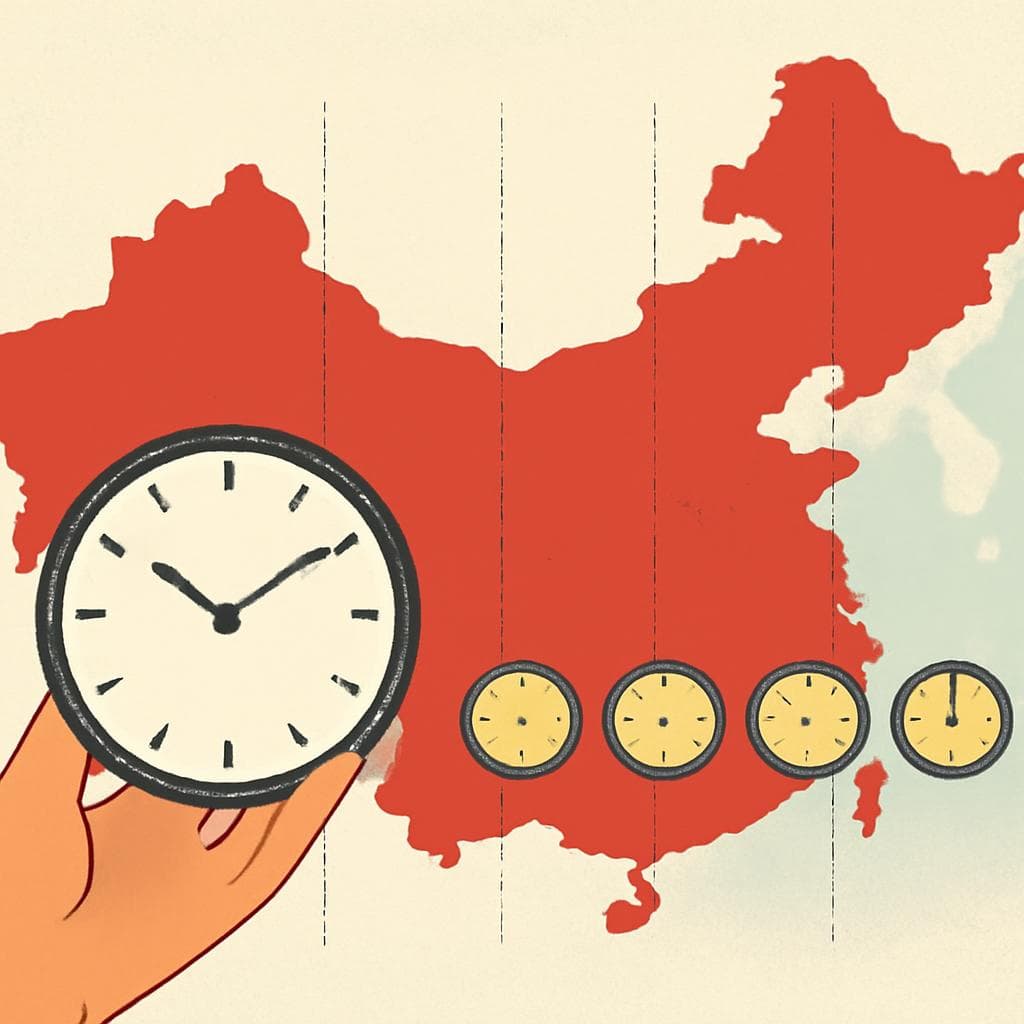
The Quiz Question
How many time zones does China officially use?
- A. One
- B. Three
- C. Five
- D. Nine
The answer is A. One. Here is the full story.
One Country, One Clock
China is the fourth-largest country in the world by land area, stretching roughly 5,000 kilometres from east to west. Geographically, that span crosses what would naturally be five separate time zones. And yet, from the bustling streets of Shanghai on the Pacific coast to the remote western reaches of Xinjiang, every clock in the country shows exactly the same time: Beijing Standard Time, or UTC+8.
How Did This Happen?
It wasn't always this way. Before the People's Republic of China was founded in 1949, the country actually operated on five regional time zones. When the Communist Party came to power under Mao Zedong, one of the many sweeping changes it introduced was the unification of the entire nation under a single clock. The reasoning was straightforward: a unified time zone was a powerful symbol of national unity and central authority. One China, one time.
Beijing sits at roughly the same longitude as Perth, Australia, and UTC+8 makes perfect sense for the capital. The problem is that Ürümqi, the capital of Xinjiang in China's far northwest, sits closer to the longitude of Karachi or Kabul — places that run on UTC+5. That's a three-hour difference in solar reality that the official clock simply ignores.
What Does This Mean in Practice?
The consequences are genuinely strange for people living in western China. In Xinjiang during summer, the sun doesn't rise until around 9 or 10 in the morning by the official clock, and it stays light until well past 11 at night. Going by Beijing time, workers might be heading to the office in what feels like the middle of the night by any natural reckoning.
To cope, many Uyghur and Kazakh communities in Xinjiang unofficially follow what locals call "Xinjiang time" — essentially UTC+6, two hours behind Beijing. It's a quiet, everyday act of regional identity. Shops, mosques, and social gatherings in these communities often run on this informal local time, even while official government and transport schedules stick rigidly to Beijing Standard Time. Visitors quickly learn to ask which time system is being used.
China Isn't Alone in This Choice
China is actually the most dramatic example of a country choosing political unity over geographical logic, but it has company. India spans about two time zones' worth of longitude yet runs on a single IST (Indian Standard Time). For that matter, Spain stays on Central European Time despite being geographically aligned with the UK, largely because of its historical ties to Franco-era politics and alignment with continental Europe.
Still, China's case stands out simply because of the sheer scale. The difference between what the clock says and what the sun is doing can be as wide as three hours in the far west — a daily reminder that time, as humans experience it, is just as much a political decision as a natural one.