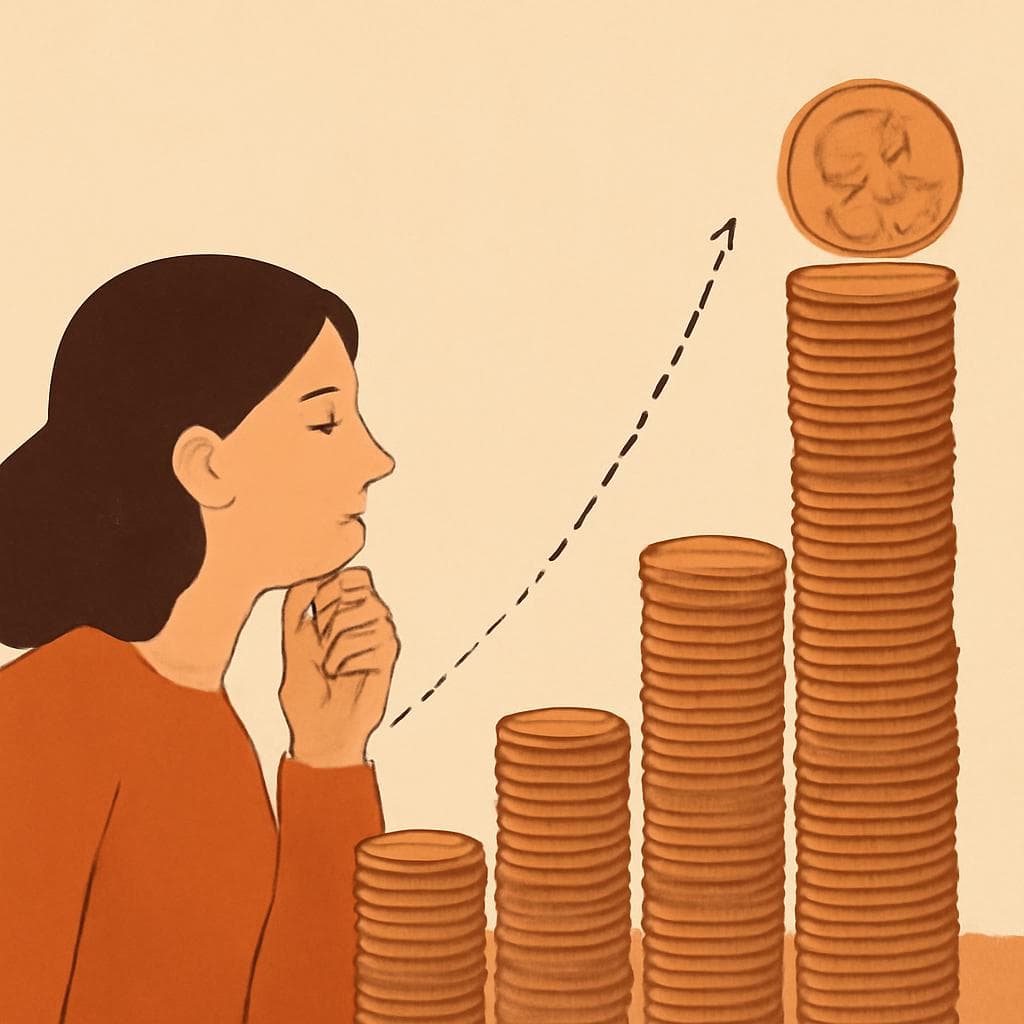
The Quiz Question
If you double a penny every day for 30 days, roughly how much do you end with?
- A. $500
- B. $10,000
- C. $5.3 million
- D. $50,000
The answer is C. $5.3 million. Here is the full story.
The Power of Doubling: Why a Single Penny Can Make You a Millionaire
It sounds almost absurd. Start with one cent, double it every day for a month, and walk away with over five million dollars. But the math is completely real — and understanding why it works will change the way you think about growth forever.
How the Numbers Actually Break Down
On Day 1, you have $0.01. On Day 2, $0.02. By the end of the first week, you're sitting at just $0.64 — nothing to get excited about. Even after two full weeks, you've only reached $81.92. It's easy to see why most people underestimate this one.
Then something remarkable happens. The curve bends sharply upward. By Day 20, you have $5,242.88. Day 25 pushes you past $167,000. Day 28 crosses the million-dollar mark. And on Day 30? You land at exactly $5,368,709.12.
That's the magic — and the madness — of exponential growth.
The Math Behind It
Each day's value is calculated by raising 2 to the power of that day number, then multiplying by a penny. Formally: value = $0.01 × 2(n-1), where n is the day. By Day 30, that's 0.01 × 229 — which equals 0.01 × 536,870,912, giving you that jaw-dropping $5.3 million figure.
The key is that every gain compounds on everything that came before it. You're not just adding a fixed amount — you're multiplying the entire accumulated total each single day.
Why Our Brains Get It Wrong
Humans are naturally wired for linear thinking. We expect growth to look like a straight line — a little more each day at a steady pace. Exponential growth doesn't work that way. It's slow and almost invisible at first, then explosive and almost incomprehensible at the end. Psychologists call our failure to grasp this "exponential growth bias," and it affects everything from how we assess debt and savings to how we perceive the spread of disease.
In fact, studies have shown that when people are asked to estimate the result of doubling a penny for 30 days, the most common guesses fall somewhere between $1,000 and $100,000 — orders of magnitude too low.
Where This Principle Shows Up in Real Life
This isn't just a fun thought experiment. Compound interest in savings and investments operates on exactly the same principle. Albert Einstein reportedly called compound interest "the eighth wonder of the world" — though historians debate whether he actually said it, the sentiment holds true regardless.
Epidemic modeling, population growth, viral content online — exponential curves appear everywhere once you know to look for them.
The penny riddle is a perfect illustration of why starting early with investments — even tiny ones — matters so much. The longer the doubling has to run, the more dramatic the final result. The last few days of that 30-day run account for more value than all the previous days combined.
Small beginnings, given enough time and consistent growth, can produce staggering results.