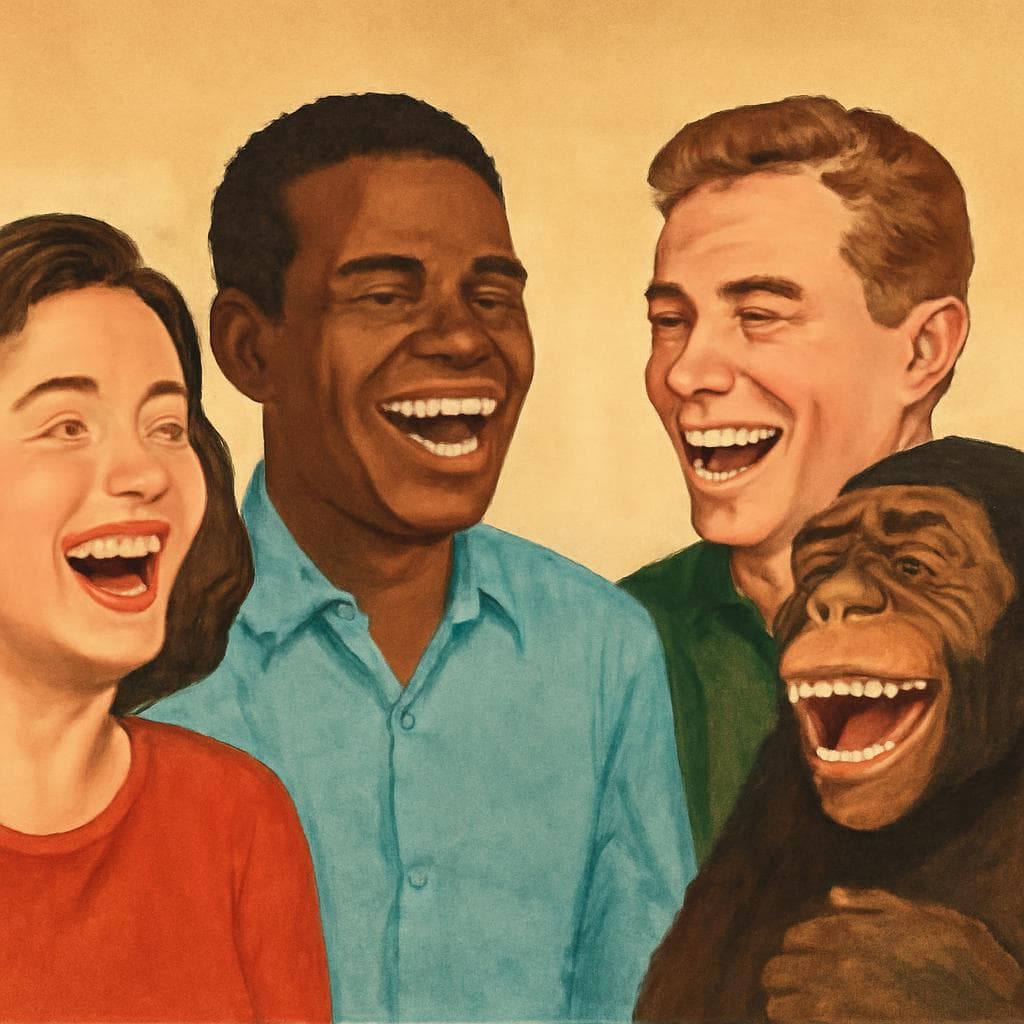
The Quiz Question
Humans are the only animals that laugh
- A. True
- B. False
- C. Mostly humans
- D. Unknown
The answer is B. False. Here is the full story.
Animals That Laugh: You're Not the Only One Giggling
It turns out the ability to laugh isn't a uniquely human trait — and the science behind this is genuinely fascinating. Several other species produce vocalizations that researchers now recognize as laughter-like responses, typically during play or social bonding.
Chimpanzees and the Roots of Laughter
Our closest relatives, chimpanzees, have been known to produce panting, breathy sounds when they're tickled or engaging in rough-and-tumble play. Primatologist Jan van Hooff studied this behavior extensively in the 1970s and argued it was an evolutionary precursor to human laughter. The sounds are different from our "ha ha" — more of a rapid in-and-out panting — but the context is strikingly similar. Bonobos, gorillas, and orangutans do it too.
Rats: The Surprising Gigglers
Here's the one that tends to blow people's minds. In the late 1990s, neuroscientist Jaak Panksepp discovered that rats emit high-frequency ultrasonic chirps — around 50 kHz — when they're tickled or playing with each other. Humans can't hear these sounds without special equipment. Panksepp's team found that rats would actively seek out tickling and play, and the chirping correlated with positive emotional states. His research, published in a peer-reviewed study, helped lay the groundwork for understanding animal emotions more broadly.
Dogs Might Be Doing It Too
Researcher Patricia Simonet analyzed recordings of dogs at play and identified a breathy, forced exhalation — distinct from normal panting — that seemed to occur specifically during playful interactions. When recordings of this sound were played to other dogs, they responded positively, often approaching or wagging their tails. Some animal behaviorists interpret this as a canine form of laughter, though the debate is still ongoing in the scientific community.
Why Does This Matter?
The existence of laughter-like behavior across species tells us something important: positive emotions, and the social bonding that goes with them, are not exclusive to humans. Laughter likely evolved as a signal — a way of communicating "this is safe, this is play, relax." That kind of signal would be useful for any social animal trying to navigate group living.
Jaak Panksepp, who spent decades studying the emotional lives of animals, argued that these findings have profound implications for how we think about animal welfare. If rats can experience something like joy, the ethical stakes of how we treat them shift considerably.
The Takeaway
Laughter, or something remarkably close to it, appears in multiple branches of the animal kingdom. Chimps, rats, dogs, and possibly other species all show versions of this behavior in the right social context. The next time your dog makes that odd breathy huff during a game of fetch, there's a decent chance it's having a pretty good time — and maybe even laughing along with you.