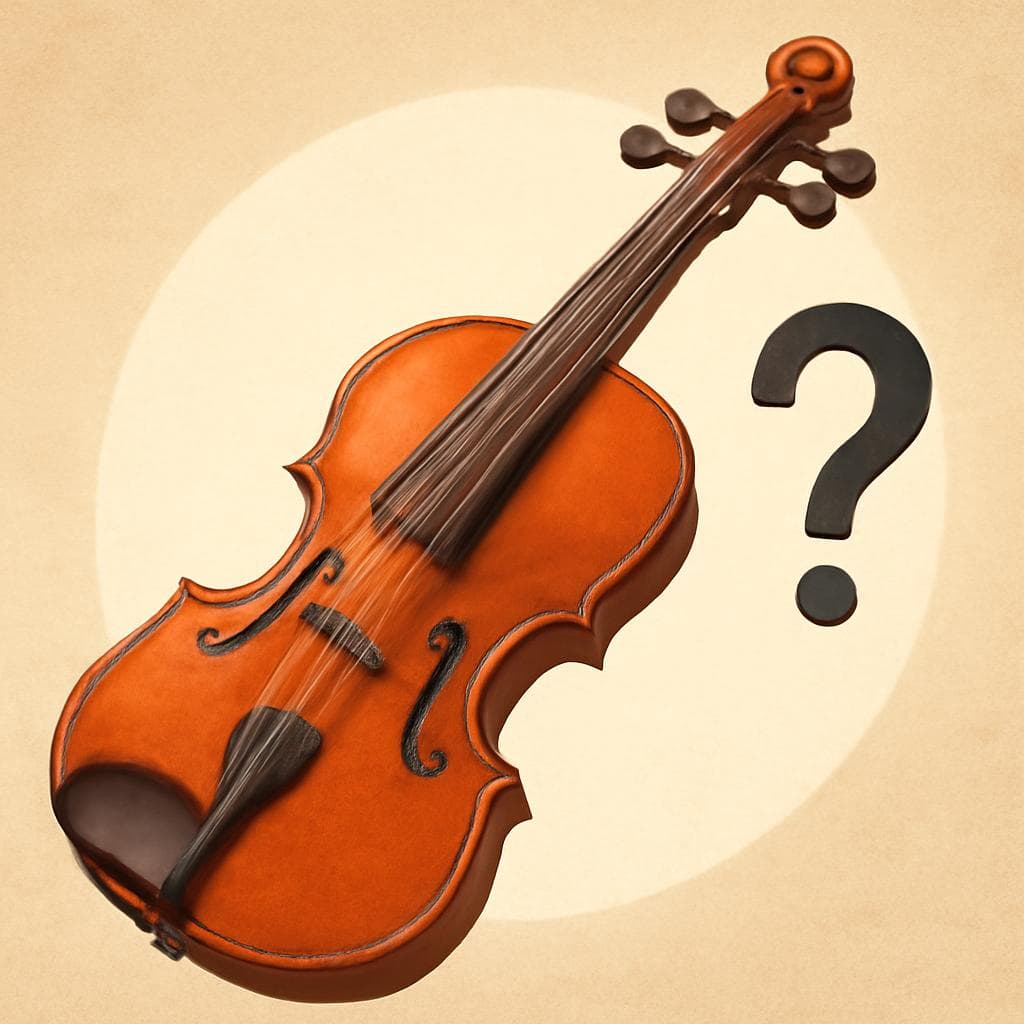
The Quiz Question
How many strings does a standard violin have?
- A. Four
- B. Five
- C. Six
- D. Seven
The answer is A. Four. Here is the full story.
The Four Strings That Changed Music Forever
Four strings. That's all it takes to produce some of the most emotionally powerful music ever written. The violin, in its standard modern form, has settled on this number for centuries — and there's a fascinating reason why that number stuck.
What Are the Four Strings?
Moving from the lowest pitch to the highest, the four strings of a violin are tuned to G, D, A, and E. Each string is a perfect fifth apart from its neighbor, meaning the interval between any two adjacent strings is the same. This consistent spacing is no accident — it gives players maximum range and flexibility while keeping the instrument physically manageable under the chin.
The lowest string, G, gives the violin its rich, warm depth. The highest, the E string, is responsible for those soaring, almost painfully beautiful high notes that make violin solos so striking. The E string is also the thinnest and is typically made from steel, while the others are often wound with materials like gut, synthetic core, or metal alloys.
A Design That Evolved Over Time
The violin didn't arrive fully formed. Its predecessors, including the medieval fiddle and the rebec, had varying numbers of strings. Early versions of the violin family that emerged in 16th-century northern Italy — largely shaped by makers in the Cremona region, including the legendary Andrea Amati — experimented with different configurations. Four strings gradually became the standard because it offered the best balance between versatility and playability.
By the time Antonio Stradivari was crafting his iconic instruments in the late 17th and early 18th centuries, the four-string layout was firmly established. Stradivari's violins, many of which still survive and sell for millions of dollars today, followed exactly this design.
Why Not More Strings?
It's a fair question. Other stringed instruments pile on many more — the guitar has six, the mandolin has eight (in pairs), and the harp can have 47. But the violin's power comes from its simplicity. Four strings allow a player to cover nearly four octaves of range through a combination of open strings, fingered notes, and a technique called shifting, where the left hand moves up and down the neck to reach higher pitches.
Adding more strings would widen the instrument, make the bow strokes more complicated, and ultimately undermine the elegant efficiency that makes the violin so expressive in skilled hands.
Still Going Strong After 500 Years
The four-string violin has anchored orchestras, defined folk music traditions from Irish reels to Appalachian fiddling, and held its own in jazz and pop. Its design has remained remarkably stable even as nearly every other piece of technology around it has transformed beyond recognition. Sometimes, four is just exactly enough.