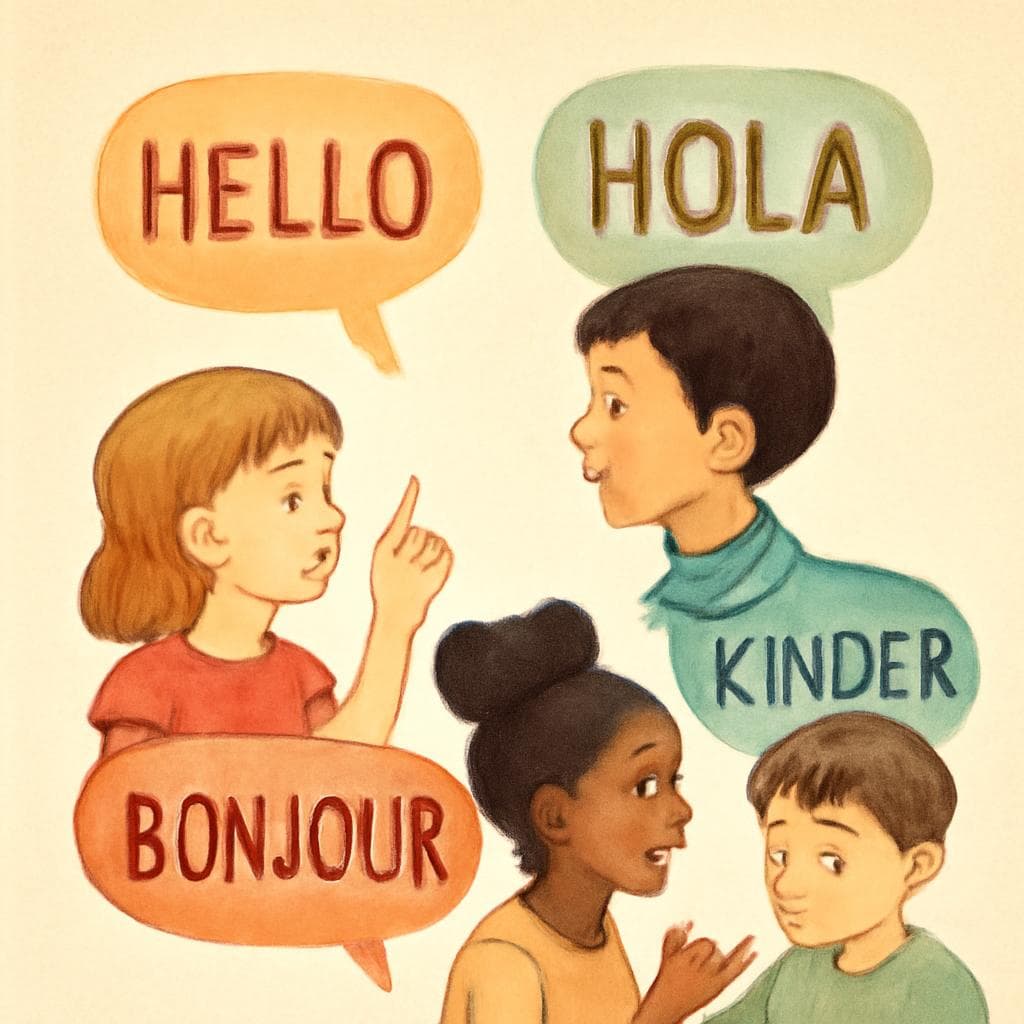
The Quiz Question
Children learn languages faster than adults.
- A. True
- B. False
The answer is A. True. Here is the full story.
Why Kids Pick Up Languages So Effortlessly
Watch a five-year-old move to a new country, and within months they're chattering away like a local. Meanwhile, their parents are still fumbling through a phrasebook. It's not just anecdotal — science backs it up. Children genuinely absorb languages faster and more completely than adults, and the reasons why are fascinating.
The Critical Period Hypothesis
Linguist Eric Lenneberg proposed back in 1967 that there is a "critical period" for language acquisition — roughly from birth to puberty — during which the brain is uniquely wired to soak up language. During these years, the brain exhibits high neuroplasticity, meaning it physically reshapes itself in response to new input. Neural pathways for language form quickly and efficiently, almost like installing software on a blank hard drive.
After puberty, the brain's plasticity decreases significantly. Learning a new language is still absolutely possible, but it demands far more conscious effort, repetition, and structured study.
Babies Are Born Ready
From birth, infants are what researchers call "universal language learners." A newborn can distinguish the sounds of every language on earth. By around 10 to 12 months, they begin specializing — tuning into the sounds of their native language and losing sensitivity to sounds they haven't heard. This window of total openness is something adults simply don't have.
Studies at the University of Washington showed that babies' brains respond to foreign language sounds in a far richer way than adult brains, lighting up regions associated with deep processing rather than surface-level recognition.
Fear and Self-Consciousness Don't Help
Children have another major advantage that has nothing to do with biology: they don't care about making mistakes. A six-year-old will mispronounce words, mix up grammar, and invent sentences with cheerful confidence. Adults, on the other hand, are often paralysed by the fear of sounding foolish. That self-consciousness actually slows learning down. The emotional filter gets in the way of pure acquisition.
Immersion Works Better Young
Children also tend to experience language through total immersion — playground games, cartoons, songs — rather than formal study. This mirrors how first languages are learned, through context and repetition rather than grammar rules. The brain internalises patterns naturally rather than translating through a mental rulebook.
Research from MIT published in 2018 analysed data from nearly 670,000 people and confirmed that true native-level grammatical fluency is almost impossible to achieve when learning starts after the age of 10, and becomes significantly harder after 18.
Still Worth Starting at Any Age
None of this means adults should give up on language learning — far from it. Adults actually learn vocabulary faster in the early stages because of their existing knowledge frameworks. But when it comes to accent, intuitive grammar, and deep fluency, the young brain has a head start that's hard to beat.
So if you want your kids to be bilingual, the best time to start is now.