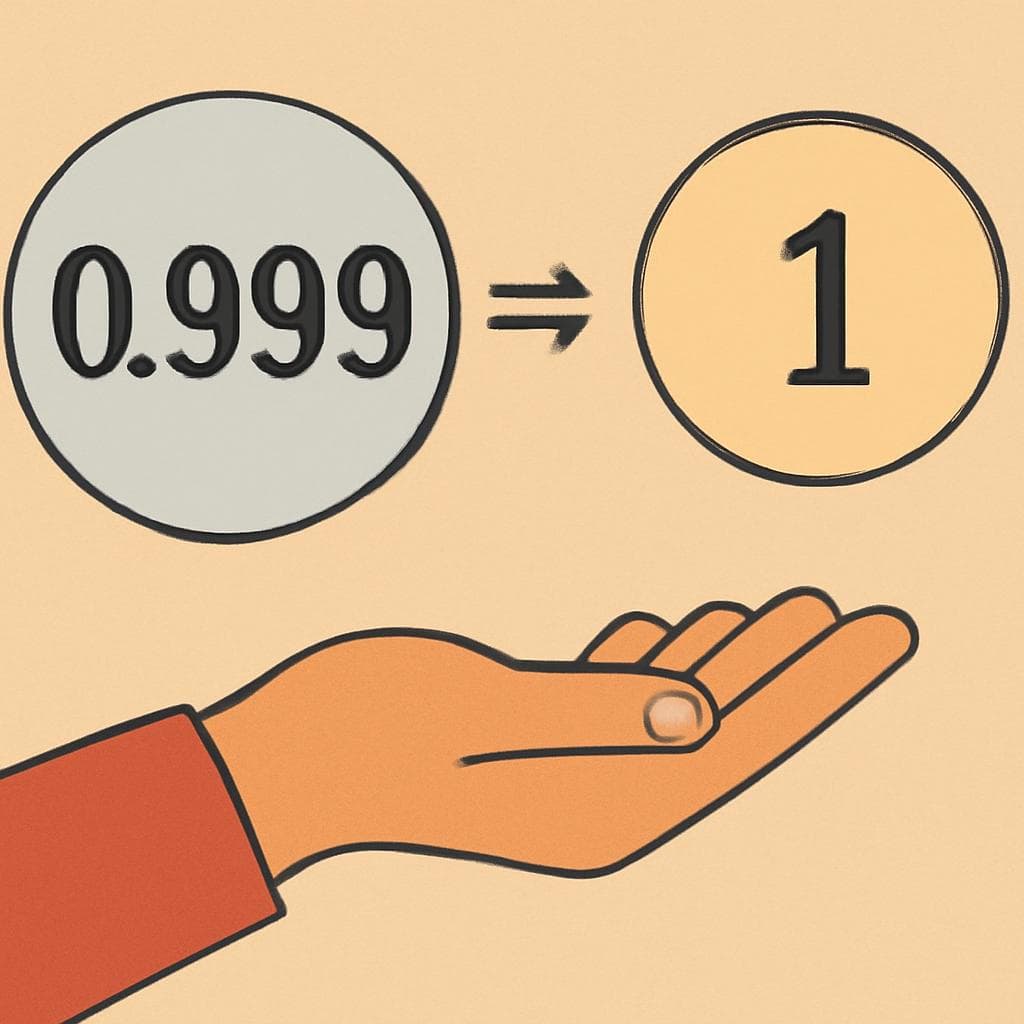
The Quiz Question
0.999 repeating forever is exactly equal to 1.
- A. True
- B. False
- C. Approximately
- D. Only in calculus
The answer is A. True. Here is the full story.
One of Maths' Most Mind-Bending Truths
It looks like it should be just a tiny sliver less than 1. Surely 0.999... and 1 are almost the same, separated by some infinitely small gap? Nope. They are exactly, provably, completely identical. This isn't a trick or a rounding shortcut — it's a genuine mathematical fact that has tripped up students and sparked arguments for generations.
The Simplest Proof You'll Ever See
Here's the most elegant way to see it. Let's call x = 0.999...
Multiply both sides by 10, and you get 10x = 9.999...
Now subtract the first equation from the second: 10x − x = 9.999... − 0.999...
That gives you 9x = 9, which means x = 1. Done. No tricks, no sleight of hand — just algebra.
The Fraction Proof Is Even Quicker
Most people are comfortable accepting that 1/3 = 0.333... repeating forever. Multiply both sides by 3, and you get 3/3 = 0.999... But 3/3 is just 1. So 0.999... = 1. It really is that straightforward.
Why Does This Feel So Wrong?
Our brains are wired to think about processes, not endpoints. We picture 0.999... as something that's getting closer to 1, always approaching but never quite arriving. But in mathematics, the notation 0.999... doesn't represent a journey — it represents the completed destination. It is the limit of the sequence 0.9, 0.99, 0.999, and so on, and that limit is exactly 1.
The concept of a limit was formalised by mathematicians like Augustin-Louis Cauchy and Karl Weierstrass in the 19th century, and it's the bedrock of calculus. Once you accept how limits work, 0.999... = 1 stops being shocking and starts being obvious.
Is There a Number Between Them?
Here's a useful challenge: try to find a number that sits between 0.999... and 1. You can't. In the real number system, if two numbers are truly different, there must be another number between them. No such number exists here, which is itself a proof that they are the same number.
It's Not Just a Quirk of Nines
The same principle applies to any repeating decimal at the top of its range. The number 2.999... is exactly 3. The number 0.4999... is exactly 0.5. Repeating nines are simply another valid way to write the next whole number up, in the same way that 4/4 and 8/8 and 100/100 are all just different names for 1.
Mathematics is full of moments where intuition leads us astray, and this is one of the most famous. The discomfort you feel looking at 0.999... = 1 is actually a sign that your instincts are bumping up against something genuinely deep about the nature of infinity and the real number line.