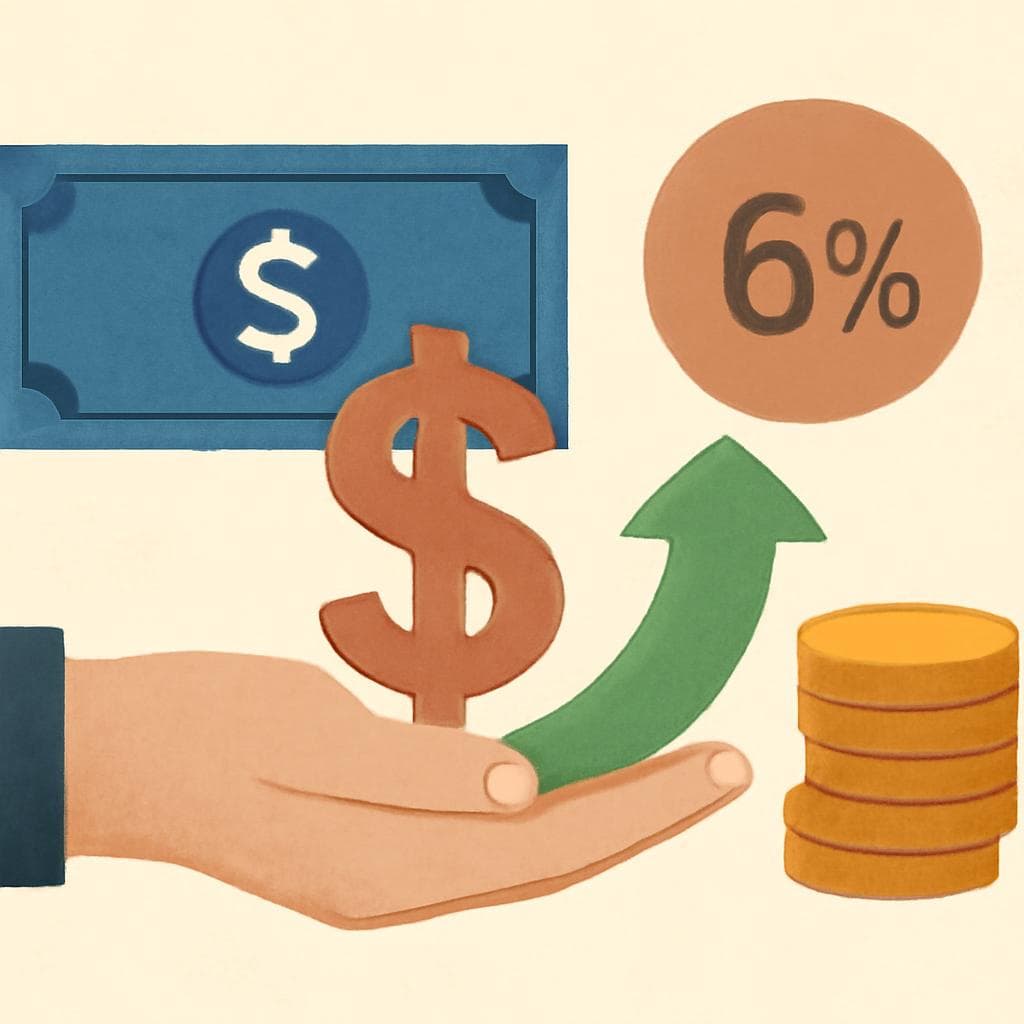
The Quiz Question
You invest $5,000 at 6% compound interest. Roughly how much after 15 years?
- A. $8,000
- B. $11,983
- C. $9,500
- D. $15,000
The answer is B. $11,983. Here is the full story.
The Magic of Compound Interest at Work
Turn $5,000 into nearly $12,000 without doing a single extra thing — that's exactly what compound interest does when you leave it alone long enough. At 6% annual compound interest over 15 years, your original $5,000 grows to approximately $11,983. You've almost doubled your money, and the only thing you contributed was patience.
The Formula Behind the Number
Compound interest is calculated using the formula A = P(1 + r/n)^(nt), where P is the principal, r is the annual interest rate, n is the number of times interest compounds per year, and t is the time in years. For this scenario, assuming annual compounding, it looks like this:
A = 5,000 × (1 + 0.06)^15 = 5,000 × 2.3966 ≈ $11,983
That multiplier — 2.3966 — is the real star of the show. It means your money grew by a factor of almost 2.4x. Simple interest at 6% would only give you $9,500 over the same period ($5,000 plus $300 per year for 15 years). Compound interest delivers nearly $2,500 more, purely because each year's interest starts earning interest of its own.
Why 6% and 15 Years?
Six percent is a historically reasonable benchmark. The S&P 500, adjusted for inflation, has returned roughly 6–7% annually over long periods. Savings bonds, certain CDs, and dividend-paying stocks have all touched this range at various points. It's not a guaranteed number, but it's a credible planning assumption — the kind financial advisors often use in retirement projections.
Fifteen years is long enough for compounding to really stretch its legs, but short enough to feel tangible. If you invested $5,000 at age 35, you'd hit that $11,983 figure right around your 50th birthday — years before traditional retirement age. Start at 25, and by 40 you've already nearly doubled your stake.
The Snowball Effect in Action
In year one, you earn $300 in interest. Fine. But by year 15, you're earning closer to $680 in a single year — more than double the first year's gain — because the base keeps growing. That accelerating curve is what Albert Einstein allegedly (and almost certainly apocryphally) called "the eighth wonder of the world." Attributed or not, the math backs up the sentiment.
What This Means for Real Life
The lesson isn't just abstract math. It's a practical argument for starting early and touching the money as little as possible. Even modest contributions invested consistently at competitive rates can build serious wealth over time. A $5,000 investment that quietly compounds for 15 years does more work than most people realize — and this example makes that concrete and impossible to ignore.
The numbers don't lie: time is the most powerful ingredient in any investment strategy.