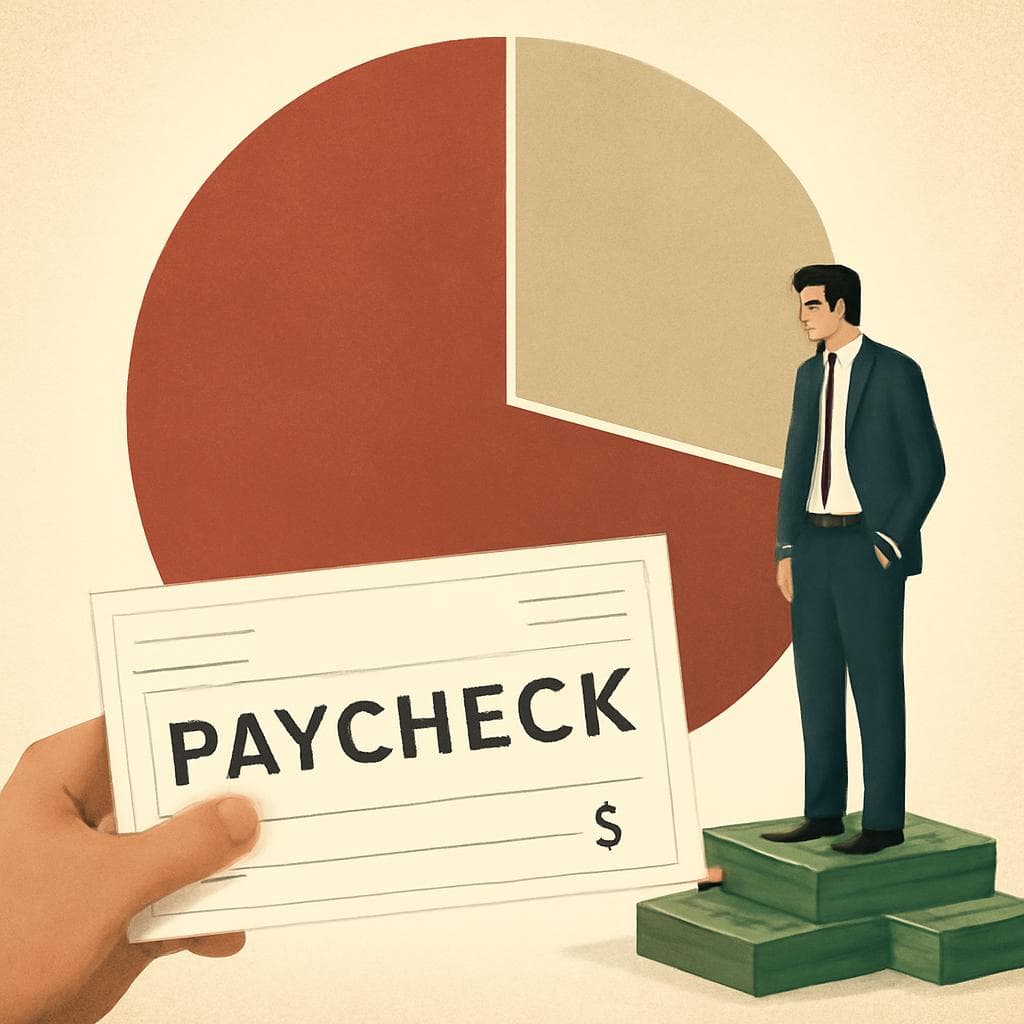
The Quiz Question
What percentage of Americans live paycheck to paycheck?
- A. About 20%
- B. About 40%
- C. About 60%
- D. About 80%
The answer is C. About 60%. Here is the full story.
The Paycheck-to-Paycheck Reality Facing Most Americans
Six out of every ten Americans are one missed paycheck away from financial trouble. That's not a recession-era statistic or a snapshot from a moment of crisis — it's the persistent, uncomfortable baseline of everyday financial life in the United States, documented consistently across multiple surveys in recent years.
Where Does This Number Come From?
Several large-scale studies have converged on the same ballpark figure. LendingClub, in partnership with PYMNTS.com, has tracked this data closely through their annual New Reality Check: The Paycheck-to-Paycheck Report. Their findings repeatedly show that around 60–63% of Americans describe themselves as living paycheck to paycheck — meaning their monthly income barely covers, or fails to cover, their monthly expenses, leaving little to no financial cushion.
The Federal Reserve's own research backs this up. Their annual Report on the Economic Well-Being of U.S. Households has found that a significant portion of Americans couldn't cover a $400 emergency expense without borrowing money or selling something. That's a telling sign of just how thin the financial margin is for millions of families.
It's Not Just Low-Income Households
Here's where the story gets surprising. Living paycheck to paycheck isn't exclusive to people earning minimum wage. LendingClub's data shows that even among Americans earning $100,000 or more per year, roughly one in three report living paycheck to paycheck. Lifestyle inflation — spending rising alongside income — means that higher salaries don't automatically translate into financial security.
Medical bills, student loan debt, rising housing costs, and childcare expenses eat into budgets at every income level. A family earning a solid middle-class income in a high cost-of-living city like San Francisco or New York can find themselves just as stretched thin as someone earning far less elsewhere.
Why This Matters Beyond Personal Finance
When the majority of the workforce has no financial buffer, the broader economy becomes fragile. Consumer spending drives roughly 70% of U.S. GDP. If a significant shock — a job loss, a health crisis, a sudden expense — hits households with no savings, spending collapses fast. That ripple effect is exactly what policymakers feared during the early days of the COVID-19 pandemic, and it's why emergency stimulus checks were deployed so quickly.
It also explains why high-interest products like payday loans, buy-now-pay-later services, and credit card debt remain so popular despite their steep costs. When you have no emergency fund, expensive credit becomes the emergency fund by default.
The Bigger Picture
The 60% figure isn't a moral failure or a sign of poor individual choices alone — it reflects decades of wage stagnation, rising costs for essential goods, and a fraying social safety net. Understanding the scale of this problem is the first step toward having an honest national conversation about financial security, savings incentives, and what it actually means to live comfortably in modern America.