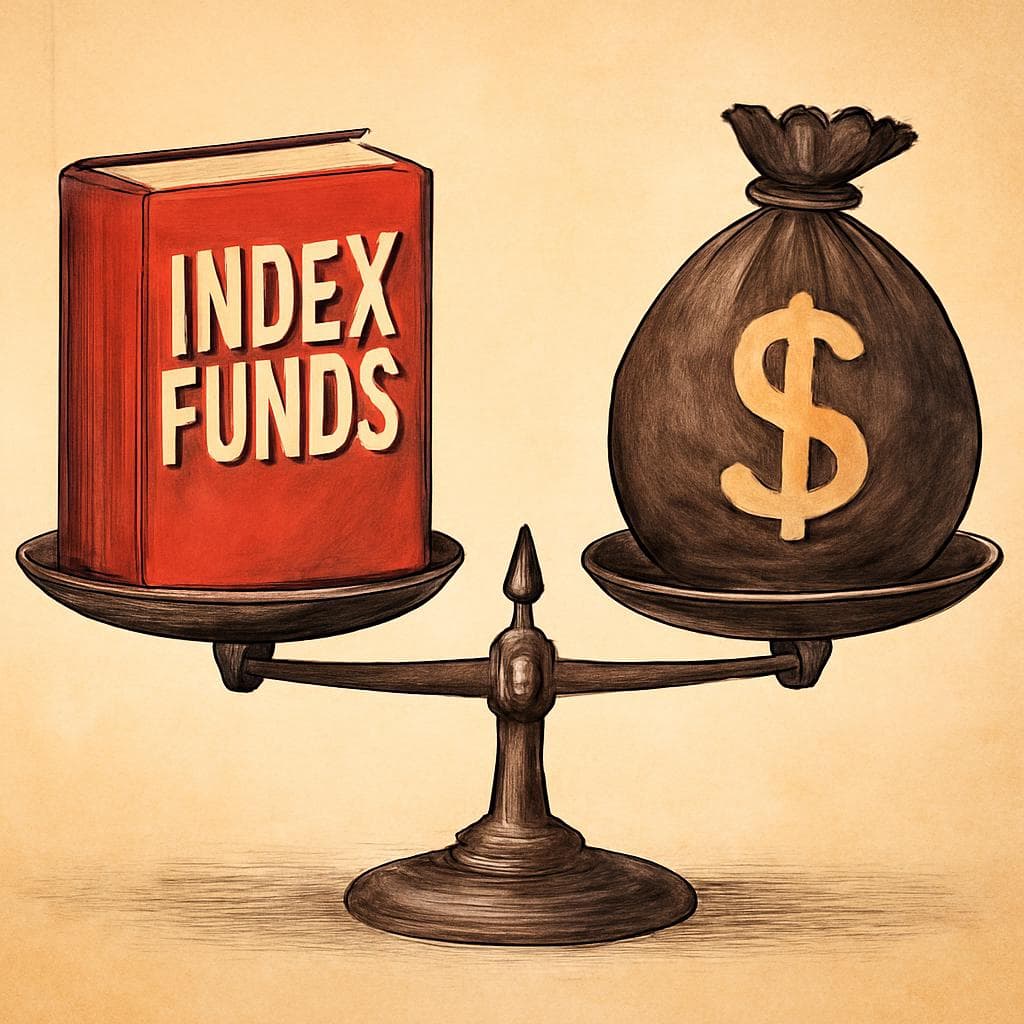
The Quiz Question
Index funds usually charge higher fees than actively managed funds.
- A. True
- B. False
The answer is B. False. Here is the full story.
Why Index Funds Are Actually the Cheaper Option
It feels like it should cost more to get a piece of the whole market, but the opposite is true. Index funds are almost always significantly cheaper than actively managed funds — and the gap is bigger than most people realize.
The Numbers Behind the Fees
Fees on investment funds are measured by what's called the expense ratio — the annual percentage of your investment that goes toward running the fund. For actively managed funds, the average expense ratio in the U.S. hovers around 0.60% to 1.00% per year, and some specialty funds charge even more. Index funds, by contrast, can cost as little as 0.03% per year. Vanguard's S&P 500 index fund and Fidelity's ZERO funds are famous examples of rock-bottom pricing.
That might sound like a trivial difference, but compounded over decades, it's enormous. On a $100,000 investment over 30 years, the difference between a 1% and a 0.05% fee can translate to tens of thousands of dollars lost to costs alone.
Why Active Funds Cost So Much More
Actively managed funds employ teams of professional analysts and portfolio managers who research companies, time trades, and constantly adjust holdings trying to beat the market. All of that human expertise, research infrastructure, and trading activity costs money — and those costs get passed directly to investors through higher fees.
Index funds, on the other hand, don't try to outsmart the market. They simply track a benchmark index like the S&P 500, buying and holding the same stocks in the same proportions as the index. There's no expensive research team, minimal trading, and very little overhead. It's essentially automated investing — and automation is cheap.
The Performance Irony
Here's the twist that stings a little: despite charging more, actively managed funds rarely outperform their index fund counterparts over the long term. According to S&P's SPIVA report — one of the most cited scorecards in the industry — over any given 15-year period, roughly 85% to 90% of active large-cap fund managers fail to beat the S&P 500. So investors are often paying more for worse results.
This insight is a big part of why passive investing has exploded in popularity. By 2024, index funds and other passive strategies controlled more assets in the U.S. stock market than actively managed funds — a historic tipping point that would have seemed unthinkable 30 years ago.
What This Means for Everyday Investors
Fees matter enormously in investing because they compound just like returns do — only in the wrong direction. Choosing a low-cost index fund over a high-fee active fund is one of the simplest, most evidence-backed moves any investor can make. It's the rare case where doing less — and paying less for the privilege — actually tends to get you more.