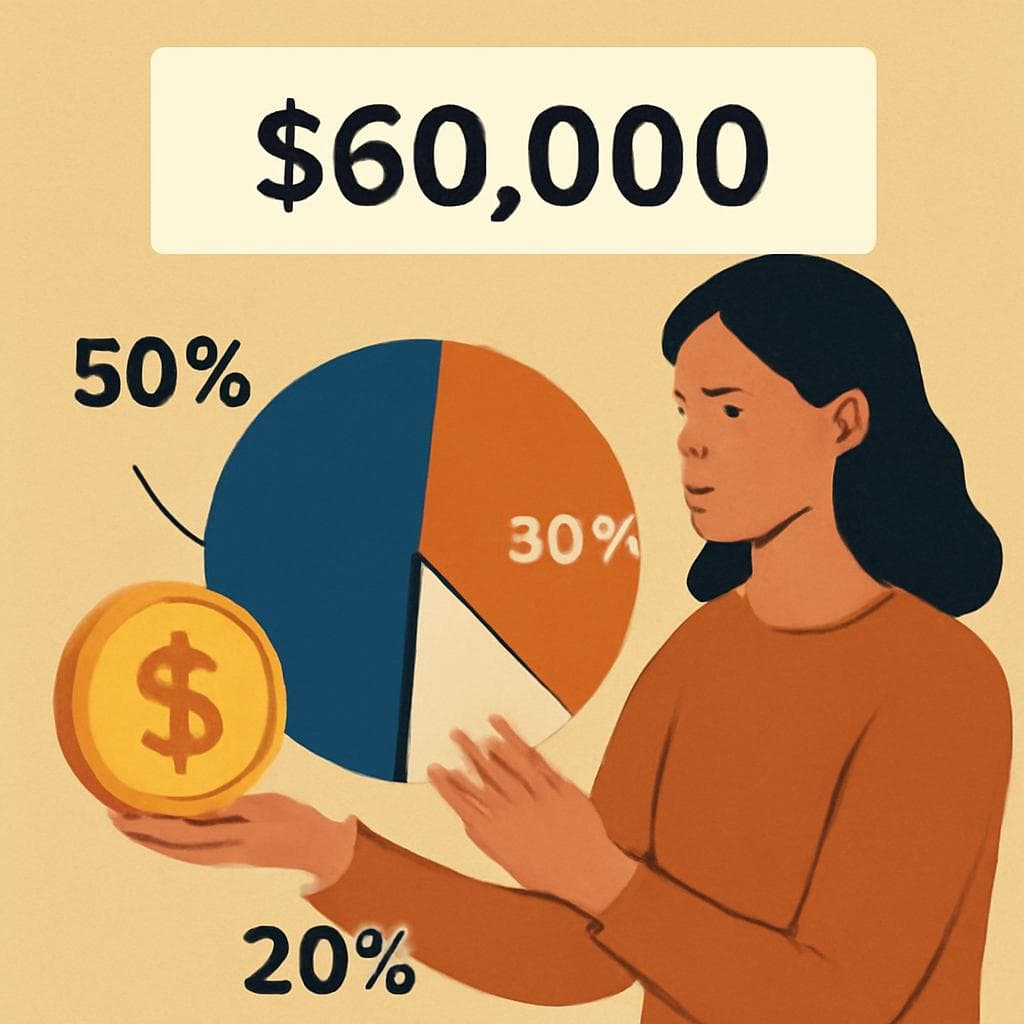
The Quiz Question
If your salary is $60,000 and you follow the 50/30/20 rule, how much goes to savings?
- A. $6,000
- B. $12,000
- C. $18,000
- D. $30,000
The answer is B. $12,000. Here is the full story.
Breaking Down the 50/30/20 Rule
The 50/30/20 rule is one of the most popular personal finance frameworks out there, and for good reason — it's simple, flexible, and gives your money a clear purpose. On a $60,000 salary, that means $12,000 every year is earmarked for savings and financial goals. Here's how the math works and why this rule has become a household name in budgeting.
Where Did This Rule Come From?
The framework was popularized by U.S. Senator and bankruptcy law expert Elizabeth Warren and her daughter Amelia Warren Tyagi in their 2005 book All Your Worth: The Ultimate Lifetime Money Plan. Warren wasn't trying to create a rigid system — she wanted a rule of thumb that almost anyone could follow without a spreadsheet or financial advisor.
The idea caught on fast. It's now recommended by banks, financial apps like Mint and YNAB, and countless money coaches worldwide.
The Three Buckets Explained
On a $60,000 gross salary, your take-home pay after federal taxes will vary by state and filing status, but the rule is typically applied to your after-tax income. Let's say your take-home is around $48,000 annually — a reasonable estimate for many single filers.
- 50% for Needs ($24,000): Rent or mortgage, groceries, utilities, insurance, minimum debt payments — the non-negotiables.
- 30% for Wants ($14,400): Dining out, streaming services, vacations, hobbies — the things that make life enjoyable but aren't strictly necessary.
- 20% for Savings ($9,600): Emergency fund, retirement contributions, paying down extra debt, investments.
Now, the quiz uses the gross salary of $60,000 to calculate savings, which gives you the clean $12,000 figure (20% of $60,000). This is a common way the rule gets illustrated, even if real-world budgeting usually starts from net pay.
Why the 20% Savings Slice Matters So Much
Financial experts widely recommend saving at least 15% of your income for retirement alone, according to guidelines from Fidelity Investments. The 20% bucket in this rule covers that and then some — including building an emergency fund of three to six months of expenses, a benchmark set by the Consumer Financial Protection Bureau (CFPB).
Saving $12,000 a year at age 30, invested in an index fund averaging 7% annual returns, could grow to over $1.1 million by age 65. That's the real power hiding inside this simple percentage.
Is It Right for Everyone?
The 50/30/20 rule isn't perfect for every situation. People in high cost-of-living cities may find 50% barely covers rent alone. Those with significant debt might need to shift more toward repayment. But as a starting framework, it gives you a clear, honest look at whether your spending habits are actually aligned with your financial future.
Think of it less as a strict rule and more as a reality check — one that puts $12,000 of intention behind every $60,000 earned.