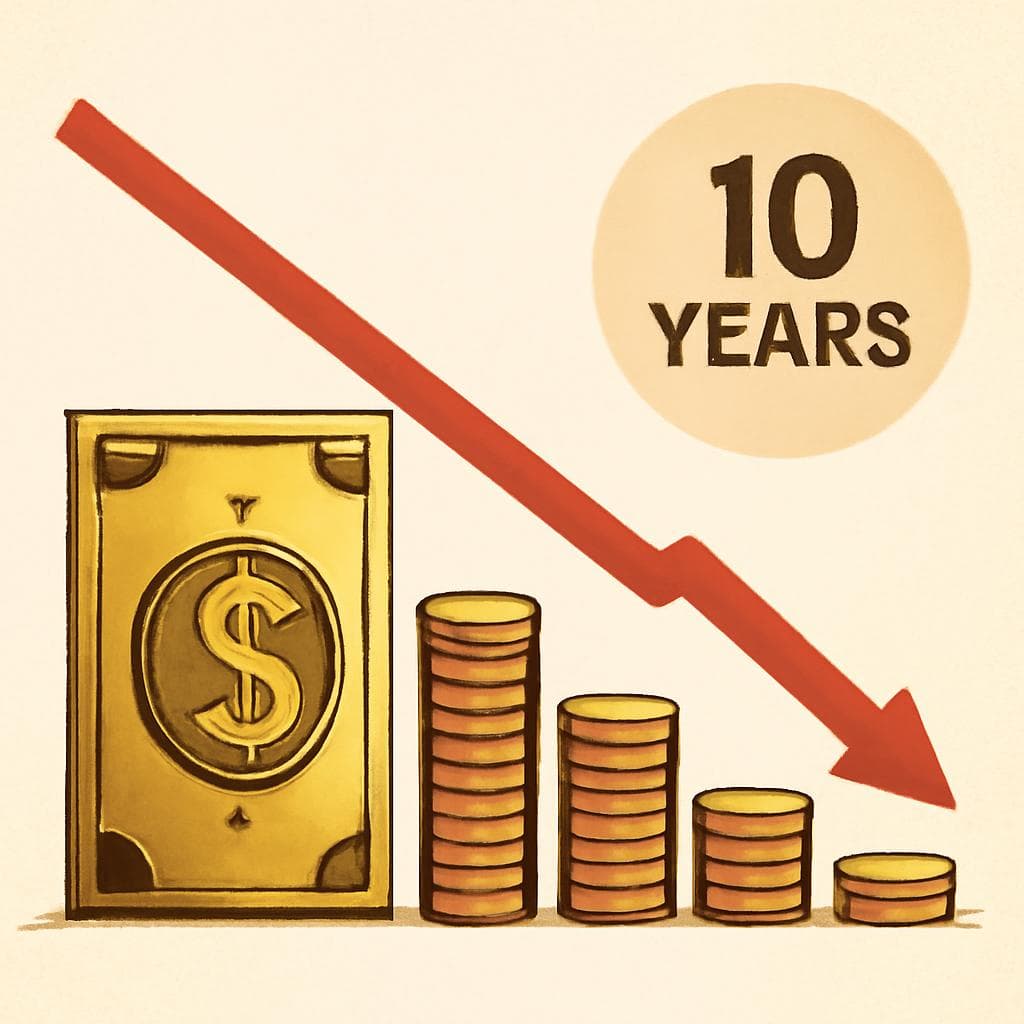
The Quiz Question
If inflation is 3% a year, how much will $100 be worth in real terms after 10 years?
- A. $74
- B. $90
- C. $97
- D. $60
The answer is A. $74. Here is the full story.
How Inflation Quietly Shrinks Your Money
Three percent a year doesn't sound like much. It's barely noticeable from one month to the next. But stretch that out over a decade and something striking happens — your $100 bill can only buy what $74 worth of goods could purchase today. That's a 26% loss in purchasing power, and you didn't spend a single cent.
The Math Behind the Erosion
The calculation uses a straightforward formula: divide your original amount by (1 + inflation rate) raised to the power of the number of years. So for 3% inflation over 10 years, you divide $100 by 1.03 to the power of 10, which equals roughly 1.3439. That gives you approximately $74.41 in today's money.
This is the same logic banks and economists use when talking about "real" versus "nominal" values. Nominal is the face value — the number printed on the note. Real value is what that number actually buys you in the real world.
The Rule of 72 Gives You a Shortcut
There's a handy trick called the Rule of 72 that helps you estimate how long it takes for inflation to cut purchasing power in half. Simply divide 72 by the inflation rate. At 3%, that's 72 ÷ 3 = 24 years. So in roughly two decades, your $100 becomes the equivalent of $50 in today's terms. At 6% inflation, it happens in just 12 years.
Why This Matters for Savings
If you tuck $100 under your mattress today and retrieve it in 10 years, you'll still have $100 — but it'll feel more like $74. This is why financial advisors consistently warn against leaving large sums in low-interest accounts. If your savings account earns 1% annually while inflation runs at 3%, you're effectively losing 2% of real value every single year.
The Federal Reserve in the United States officially targets a 2% inflation rate as a sign of a healthy, growing economy. Even at that lower rate, $100 becomes worth about $82 in real terms after 10 years. Inflation is essentially the cost of living in a growing economy — unavoidable, but manageable if you plan around it.
Inflation Through History
The 3% figure used in this question is actually fairly mild by historical standards. During the 1970s, U.S. inflation peaked at over 14% in 1980. At that rate, purchasing power halves in just five years. More recently, post-pandemic inflation surged past 9% in the U.S. in mid-2022, a 40-year high that rattled consumers and policymakers alike.
Understanding inflation isn't just a finance-class exercise. It directly affects retirement planning, wage negotiations, and every major financial decision you make. That $74 figure is a reminder that time itself has a price tag — and inflation is the one doing the charging.