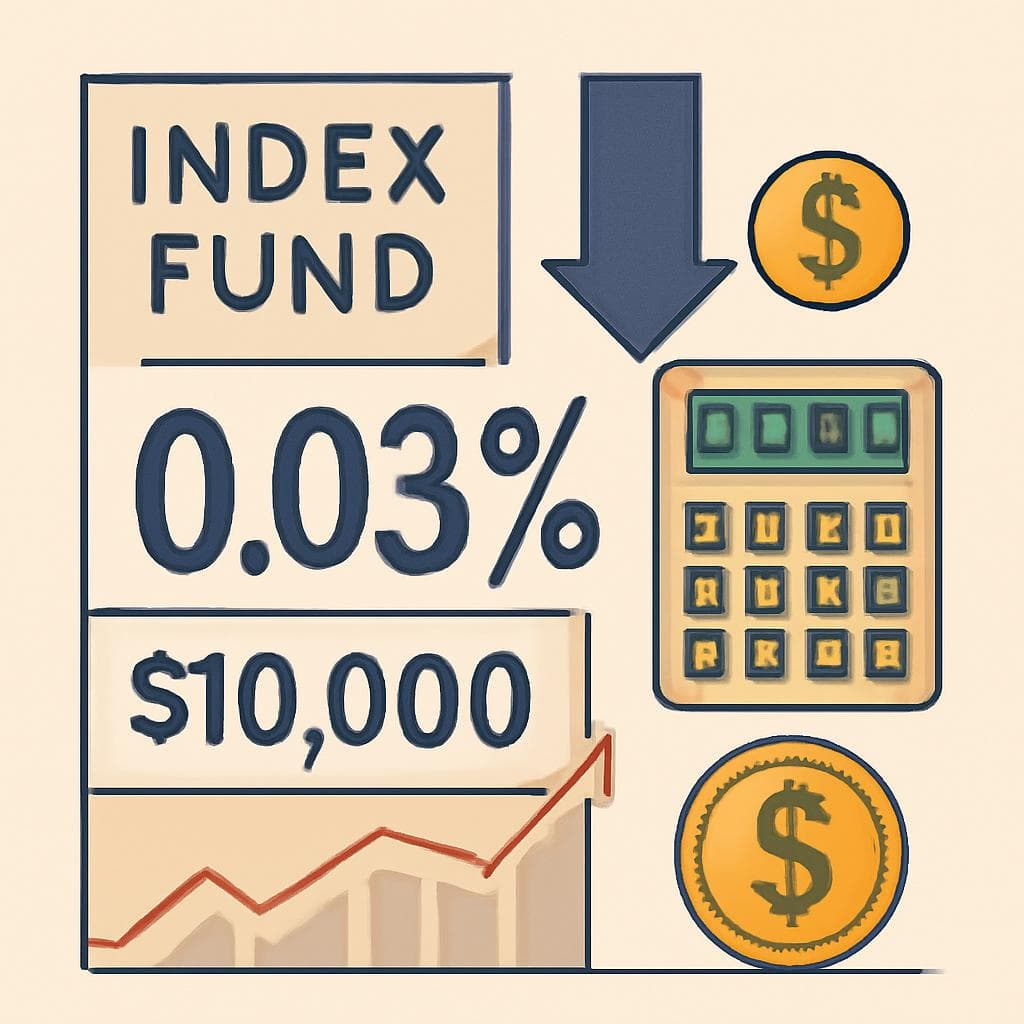
The Quiz Question
An index fund charges a 0.03% expense ratio. On a $10,000 investment, what's the annual fee?
- A. $3
- B. $30
- C. $300
- D. $0.30
The answer is A. $3. Here is the full story.
Why $3 a Year Is Actually Kind of Revolutionary
Three dollars. That's what you'd pay annually to have a professional investment fund manage a $10,000 slice of your money — less than a single cup of coffee at most cafés. It sounds almost too good to be true, but the math is straightforward: 0.03% of $10,000 works out to exactly $3.00 per year.
Breaking Down the Expense Ratio
An expense ratio is the annual fee a fund charges to cover its operating costs — things like administrative expenses, compliance, and portfolio management. It's expressed as a percentage of your total investment and is automatically deducted from the fund's assets, so you never write a check or see it leave your account directly. It quietly comes out of your returns.
At 0.03%, we're talking about one of the lowest expense ratios in the entire investment industry. Funds like the Vanguard S&P 500 ETF (VOO) and the Fidelity ZERO Large Cap Index Fund sit at or near this level. These are not obscure financial instruments — they're among the most widely held investments in the world.
The Historical Context Makes This Even More Striking
In the 1970s, when Vanguard founder John Bogle launched the first publicly available index fund, actively managed mutual funds routinely charged expense ratios of 1% to 2% or more. On that same $10,000 investment, a 1% fee would cost you $100 per year — and compounded over decades, that difference becomes enormous.
A study by the SEC found that a 1% annual fee difference on a $100,000 investment over 20 years could cost an investor more than $30,000 in lost returns. That's the compounding effect working against you when fees are high.
Why Index Funds Can Charge So Little
Index funds aren't trying to beat the market — they're just tracking it. A fund following the S&P 500 simply buys the same 500 stocks in the same proportions as the index. There's no team of analysts doing deep research, no high-frequency trading strategies, no star portfolio manager collecting a bonus. The whole operation is largely automated, which slashes costs dramatically.
That simplicity is a feature, not a bug. Decades of data show that most actively managed funds fail to outperform their benchmark index over the long term — and when you factor in their higher fees, the gap widens further.
Small Number, Big Idea
The $3 fee isn't just a math problem — it represents a fundamental shift in how ordinary people can access the financial markets. Low-cost index investing has democratized wealth building in a way that simply didn't exist 50 years ago. Whether you're investing $1,000 or $1,000,000, the principle stays the same: keep costs low, stay diversified, and let compounding do its work over time.
Sometimes the most powerful financial tool is also the cheapest one.